The AI revolution is here, but navigating the crowded landscape of AI tools can feel overwhelming, especially for video creators and marketing teams across industries like automotive, non-profits, and e-commerce. The real challenge isn’t just finding a tool; it’s finding the right tool that integrates seamlessly into your workflow, saves you time, and genuinely elevates your content. Many lists offer surface-level rundowns, but for a deeper dive into platforms specifically geared towards video production, exploring resources like this guide to the 12 Best AI Tools for Video Creation can provide valuable context.
This guide cuts through the noise with a different approach. We are not just listing features; we are providing a strategic roundup of 12 essential AI platforms and marketplaces categorized by function, from generative video and voice to scriptwriting and asset creation. This comprehensive resource is designed to be actionable, helping you discover, compare, and implement solutions that fit your specific needs.
You’ll learn how to pair these powerful AI tools with platforms like Wideo to build efficient, scalable video campaigns that deliver real results. Each entry includes direct links and screenshots to help you evaluate the options quickly. Whether you’re a small marketing agency looking to produce ads faster or an enterprise HR department automating personalized training videos, this is your playbook for making AI a practical, powerful part of your video strategy. We get straight to the point, showing you which platforms solve specific problems so you can start building a more intelligent workflow today.
1. Wideo
Wideo earns its top spot as a premier choice among AI tools by blending a user-friendly, no-code video creation platform with a powerful suite of AI-driven features. It’s an exceptionally well-rounded solution for marketing teams, agencies, and enterprises aiming to produce professional-grade animated videos and presentations without the steep learning curve or high costs of traditional production. The platform’s core strength lies in its template-driven, drag-and-drop editor, which empowers users to generate polished content in minutes, not days.
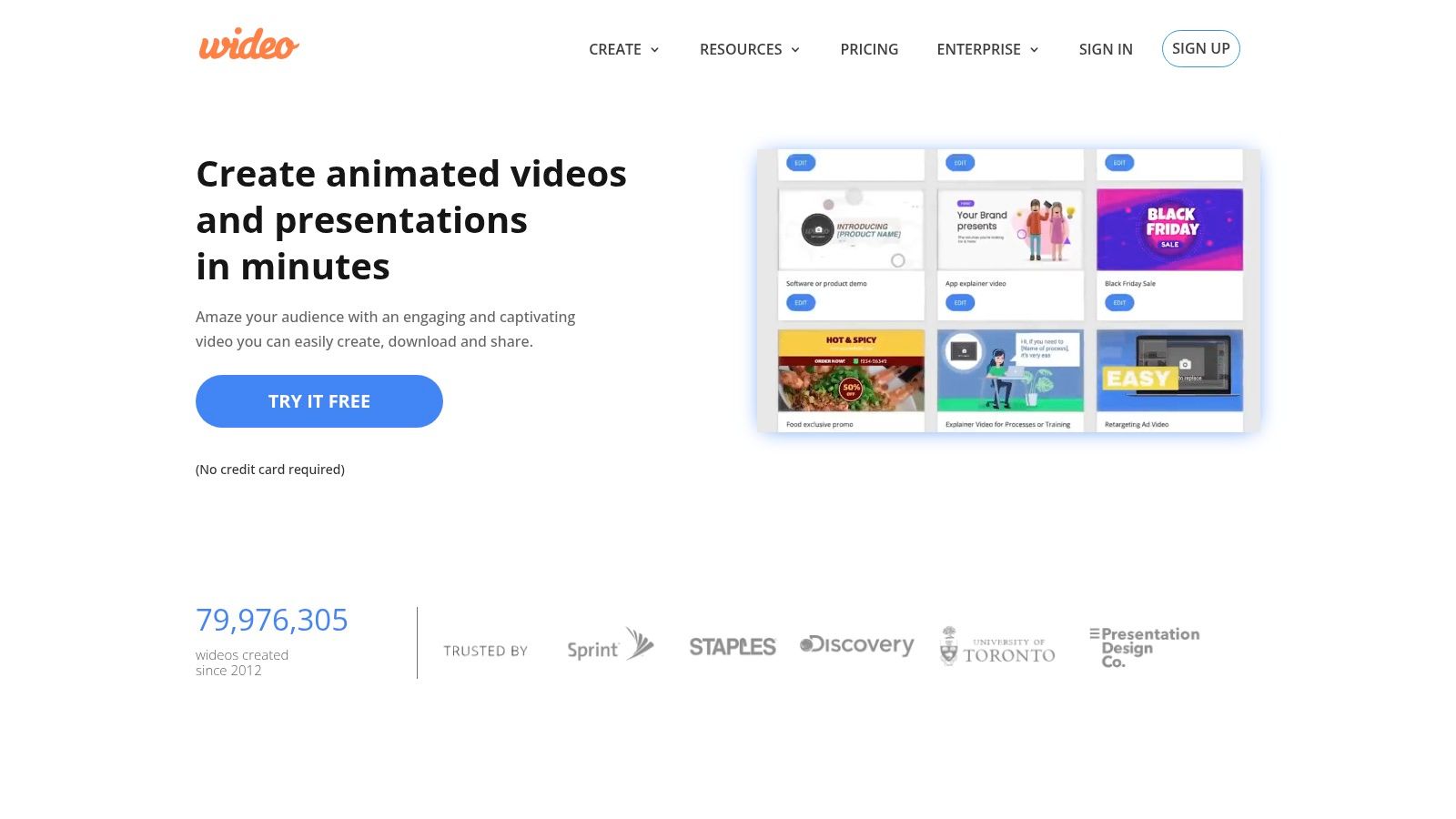
What truly sets Wideo apart is its thoughtful integration of AI to solve practical business challenges. This isn’t just a basic video editor; it’s an intelligent content engine. Its standout AI capabilities automate and enhance the entire creation process, from initial concept to final distribution.
Key Features and Use Cases
- AI Voice Generation & Avatars: Instantly create professional voiceovers in multiple languages or bring scripts to life with AI-powered avatars. This is ideal for HR onboarding videos, product tutorials, and multilingual marketing campaigns where recording human talent is impractical or too expensive.
- Blog-to-Video Conversion: Wideo’s AI can automatically transform existing blog posts or articles into engaging summary videos. This allows content teams to repurpose written content for platforms like YouTube and social media, maximizing reach with minimal effort.
- Automated Personalized Video Campaigns: This enterprise-grade feature is a game-changer for large-scale communication. Businesses like car dealerships, insurance companies, and nonprofits can use API integrations to automatically generate thousands of personalized videos, using customer data to populate names, specific offers, or appointment details, dramatically boosting engagement and conversion rates.
Pros and Cons
| Strengths | Limitations |
|---|---|
| Fast, No-Code Creation: Hundreds of templates and a drag-and-drop editor make video production accessible to non-designers. | Cloud-Based Platform: Requires a stable internet connection and is not designed for complex, frame-by-frame post-production. |
| Powerful AI Features: Voice generation, AI avatars, and text-to-video tools enable scalable and personalized video creation. | Advanced Features in Higher Tiers: API access and white-label automation are typically reserved for enterprise-level plans. |
| Enterprise-Ready Automation: White-label options and API support large-scale, personalized video workflows. | |
| Platform Maturity: With nearly 80 million videos created, it’s a proven and reliable tool with strong social proof. |
Pricing and Access
Wideo operates on a scalable pricing model suitable for individuals, teams, and large enterprises. A free trial is available (no credit card required), allowing you to explore the basic features. For advanced capabilities like API access, white-label solutions, and unlimited video creation, you will need to subscribe to one of their paid plans. It’s best to check their official website for the most current pricing details.
Website: https://wideo.co
2. OpenAI
OpenAI offers direct access to some of the most powerful and widely adopted generative AI models, including the GPT series. For marketing teams and video creators, this platform serves as a foundational layer for content ideation, scriptwriting, and strategic planning. It’s not just a chatbot; it’s a comprehensive ecosystem for generating high-quality text, analyzing data, and even creating initial visual concepts for video projects.
The platform’s strength lies in its tiered access, which scales from individual experimentation to enterprise-level integration. The straightforward web interface and mobile apps make it one of the most accessible ai tools for immediate use, allowing teams to quickly draft social media copy, brainstorm campaign slogans, or outline detailed video scripts without a steep learning curve.
Key Features and Use Cases
- Content Generation: Use ChatGPT to write video scripts, ad copy, or email marketing campaigns. For instance, an insurance agency can ask for a script explaining a complex policy in simple terms, which can then be used with an AI video generator to create an animated explainer.
- Custom GPTs: Teams can build custom versions of ChatGPT trained on their specific brand guidelines, marketing data, or product information. This ensures all generated content remains consistent and on-brand.
- Multimodal Input: The ability to upload documents, images, and data files allows for deeper analysis. A marketing agency could upload a campaign performance report and ask for insights and recommendations for the next quarter.
Pricing and Access
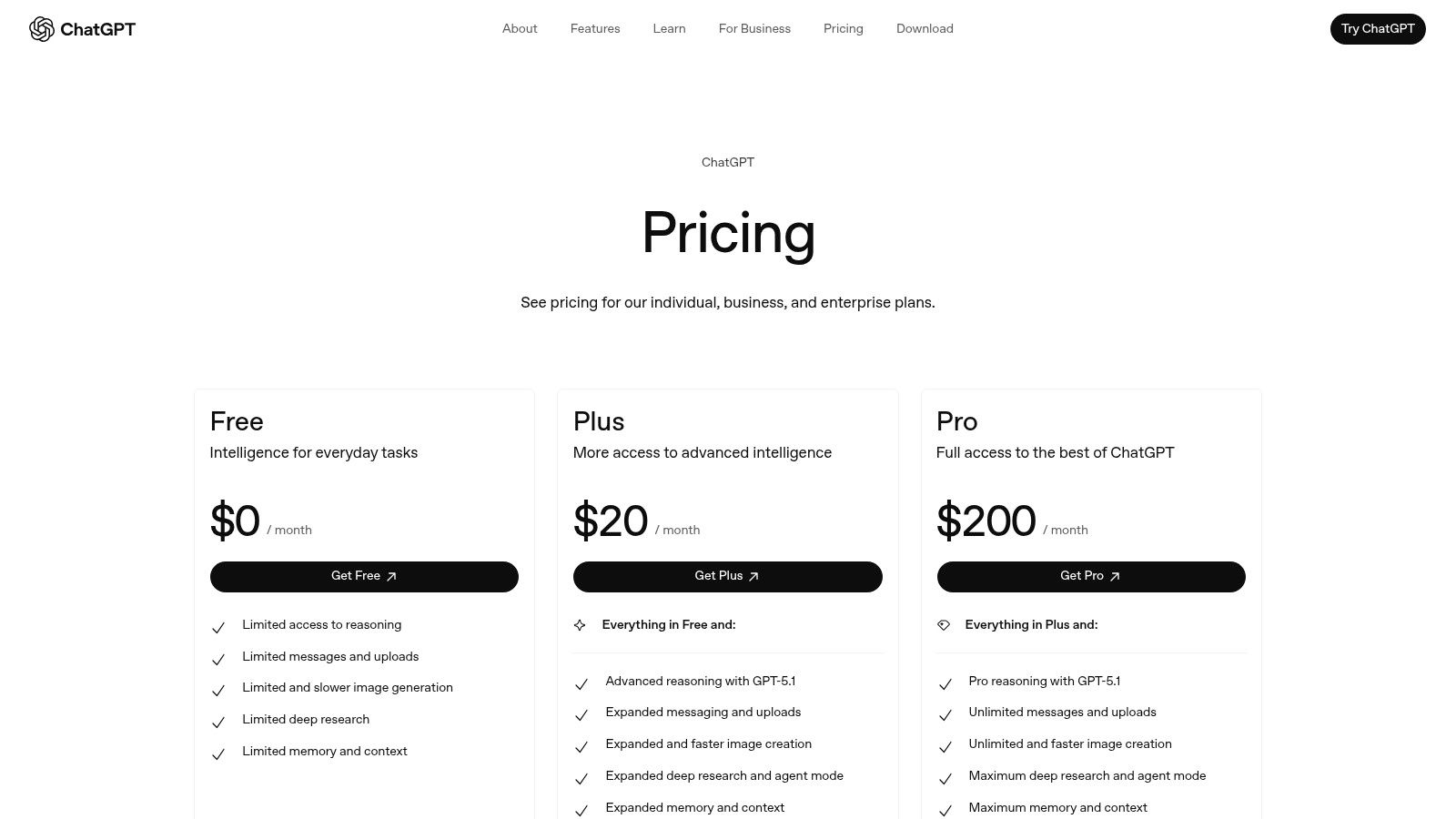
OpenAI provides a clear pricing structure that caters to different needs:
- Free: Basic access to the model.
- Plus ($20/month): Access to the latest models (like GPT-4), advanced data analysis, and the GPT Store.
- Team ($25/user/month): Higher message caps and team collaboration features.
- Enterprise: Custom solutions for large-scale deployment.
Pros and Cons
- Pros:
- Direct access to industry-leading AI models.
- Simple, intuitive user interface across all devices.
- Flexible pricing tiers for individuals and businesses.
- Cons:
- Usage caps can be restrictive during peak hours, even for paid users.
- API access for integrations is billed separately from the consumer-facing ChatGPT plans.
Website: https://openai.com/chatgpt/pricing
3. Anthropic (Claude)
Anthropic’s Claude is a powerful AI assistant that excels in complex reasoning, coding, and handling long-context tasks, making it a strong competitor in the landscape of high-end ai tools. For marketing and video teams, Claude serves as a sophisticated partner for in-depth analysis, creative brainstorming, and refining long-form content like detailed video scripts or comprehensive campaign strategies. Its core strength is its ability to process and understand vast amounts of information provided in a single prompt.
The platform is accessible through a clean web interface at claude.ai, designed for productivity and seamless workflow integrations. Its focus on constitutional AI principles also means it’s built with safety and reliability in mind, which can be a key consideration for corporate communications. This makes it ideal for tasks requiring nuanced understanding, such as summarizing customer feedback from lengthy documents or generating multiple script variations based on a detailed creative brief.
Key Features and Use Cases
- Long-Context Window: Claude can analyze entire documents, research papers, or brand guides in one go. A fintech marketing team could upload a 100-page compliance manual and ask Claude to generate a script for a short, compliant explainer video.
- Advanced Reasoning: Its strength in reasoning makes it perfect for strategic tasks. An IT marketing team can use it to break down complex technical features into simple, benefit-driven messaging for an ad campaign.
- Creative Writing and Ideation: Use Claude to draft long-form content like whitepapers, detailed video scripts, or email nurture sequences. It can maintain a consistent tone and narrative flow across extensive text.
Pricing and Access
Anthropic offers a straightforward model for accessing Claude:
- Free: A generous free tier for basic usage, available at claude.ai.
- Pro ($20/month): Provides at least 5x more usage than the free version, priority access during high-traffic periods, and early access to new features. Annual discounts are available.
- Team ($30/user/month): Builds on Pro with increased usage limits, a 200K context window, and administrative tools for team management.
Pros and Cons
- Pros:
- Excellent for tasks requiring deep reasoning and long-context analysis.
- Competitively priced for access to a high-end AI model.
- Clean, user-friendly web interface that focuses on productivity.
- Cons:
- Usage limits and pricing details can have regional variations.
- Fewer multimodal capabilities compared to some competitors.
Website: https://claude.ai
4. Hugging Face
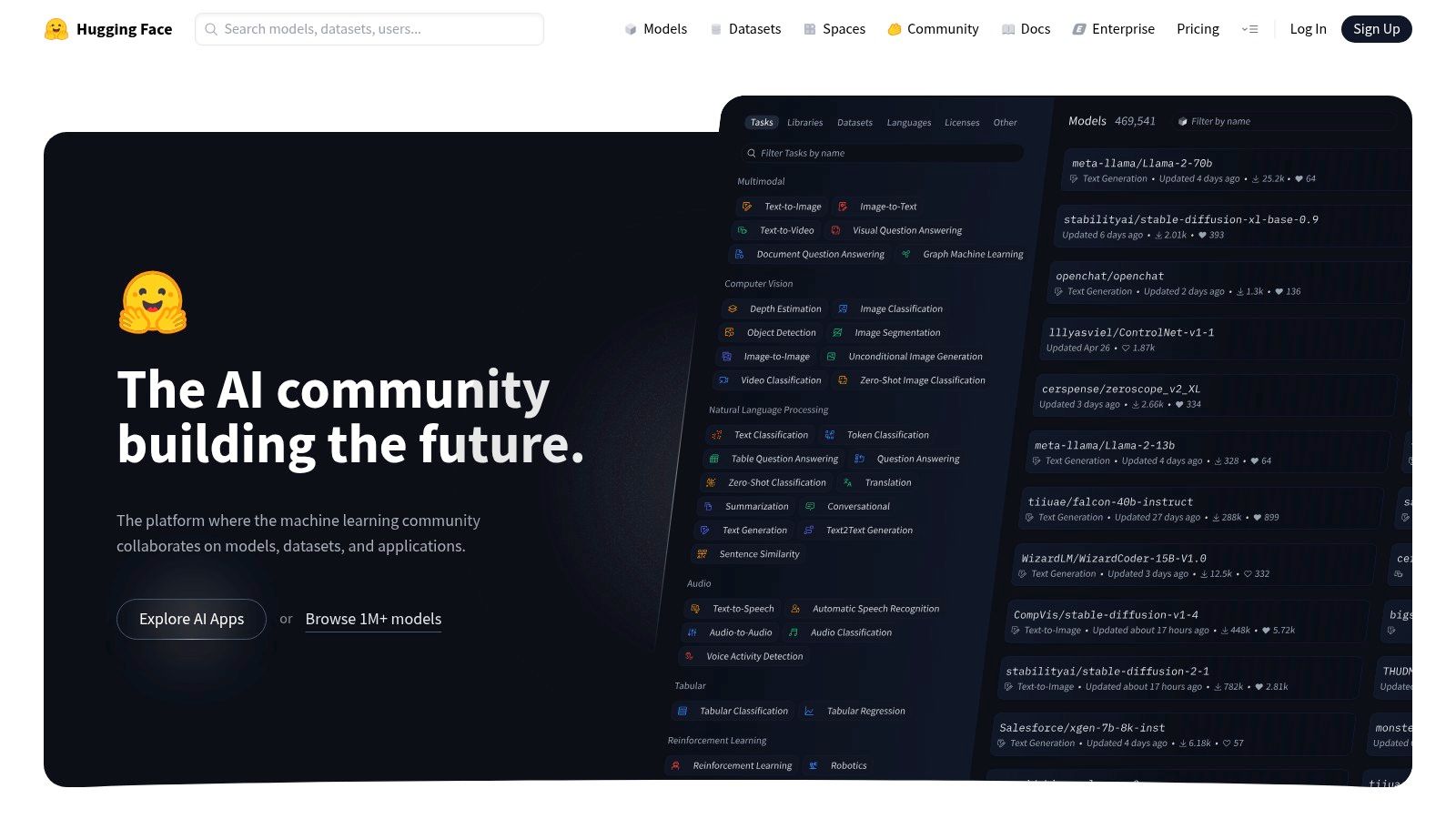
Hugging Face is a collaborative platform and open-source hub, often described as the “GitHub for machine learning.” For marketing and video teams with development resources, it provides access to a vast library of pre-trained models for tasks like text generation, summarization, and audio processing. Instead of a polished consumer interface, it offers the foundational building blocks for creating custom ai tools tailored to specific business needs.
This platform is ideal for teams wanting to move beyond off-the-shelf solutions and build proprietary AI-powered workflows. Its strength lies in its massive community and the sheer volume of available models, which can be tested in hosted “Spaces” or deployed via dedicated “Inference Endpoints.” This allows a company to experiment with a new text-to-speech model for a video campaign before committing to a full-scale integration.
Key Features and Use Cases
- Model Hub: Explore and test thousands of models for specific tasks. A telecom company could find a specialized model for analyzing customer service chat logs to identify common issues and create targeted explainer videos.
- Hosted Inference Endpoints: Deploy models on dedicated infrastructure for reliable performance. This is perfect for integrating a custom AI function, like a voice cloner, directly into a video production pipeline. Many of the advancements in text-to-speech technology are accessible through models found here.
- Spaces: Create and share interactive demos of AI applications. A marketing agency can build a quick demo of a slogan generator for a client, showcasing the potential of a custom tool before full development.
Pricing and Access
Hugging Face’s pricing is transparent and tied to infrastructure usage:
- Free: Access to the community, public models, and free Spaces hosting.
- Pro ($9/month): Private repositories and upgraded Spaces hardware.
- Enterprise ($20/user/month): Advanced security, access control, and dedicated support.
- Inference Endpoints: Billed per-instance, per-hour based on the chosen CPU or GPU, offering pay-as-you-go flexibility.
Pros and Cons
- Pros:
- Unparalleled access to a massive catalog of open-source models.
- Transparent, infrastructure-level pricing provides cost control.
- Active community for support and collaboration.
- Cons:
- Requires technical expertise to implement and manage models.
- Costs can scale quickly with high usage or powerful hardware.
Website: https://huggingface.co
5. AWS Marketplace (Machine Learning)
For enterprises and development teams already embedded in the Amazon Web Services ecosystem, the AWS Marketplace is a goldmine for pre-trained machine learning models and algorithms. This platform acts as a curated digital catalog, allowing organizations to find, subscribe to, and deploy specialized ai tools directly into their existing cloud infrastructure. It streamlines procurement and deployment, making it easier for marketing and tech teams to leverage advanced AI without building models from scratch.
The key advantage is its direct integration with Amazon SageMaker, enabling one-click deployment for a wide range of tasks from natural language processing to computer vision. This is particularly useful for large-scale operations, such as a telecom company wanting to deploy a sentiment analysis model to process customer feedback from millions of calls, or an e-commerce platform looking to implement a sophisticated product recommendation engine.
Key Features and Use Cases
- Pre-trained Models: Access hundreds of specialized models for tasks like text extraction, image recognition, and speech-to-text. A fintech marketing team could use a document analysis model to extract key information from financial reports for content creation.
- One-Click Deployment: Seamlessly deploy models into Amazon SageMaker via a simple interface or a notebook environment, significantly reducing the technical overhead for development teams.
- Consolidated Billing: All marketplace subscriptions are billed through a single AWS account, simplifying financial management and governance for large organizations with multiple departments using different AI services.
Pricing and Access
Pricing on the AWS Marketplace is model-specific and set by the individual vendors. Common models include:
- Usage-Based: Pay-as-you-go pricing based on the number of API calls or processing time.
- Monthly Subscriptions: Fixed monthly fees for continuous access to a model.
- Private Offers: Custom pricing and terms can be negotiated directly with vendors for enterprise-level use.
Pros and Cons
- Pros:
- Deep integration with the AWS ecosystem simplifies deployment and management.
- Streamlined procurement and consolidated billing are ideal for enterprise environments.
- Wide selection of specialized, pre-trained models from various vendors.
- Cons:
- Requires an AWS account and technical familiarity with AWS services like SageMaker.
- The variety of listings means pricing and model quality can be inconsistent.
Website: https://aws.amazon.com/marketplace/solutions/machine-learning/pre-trained-models
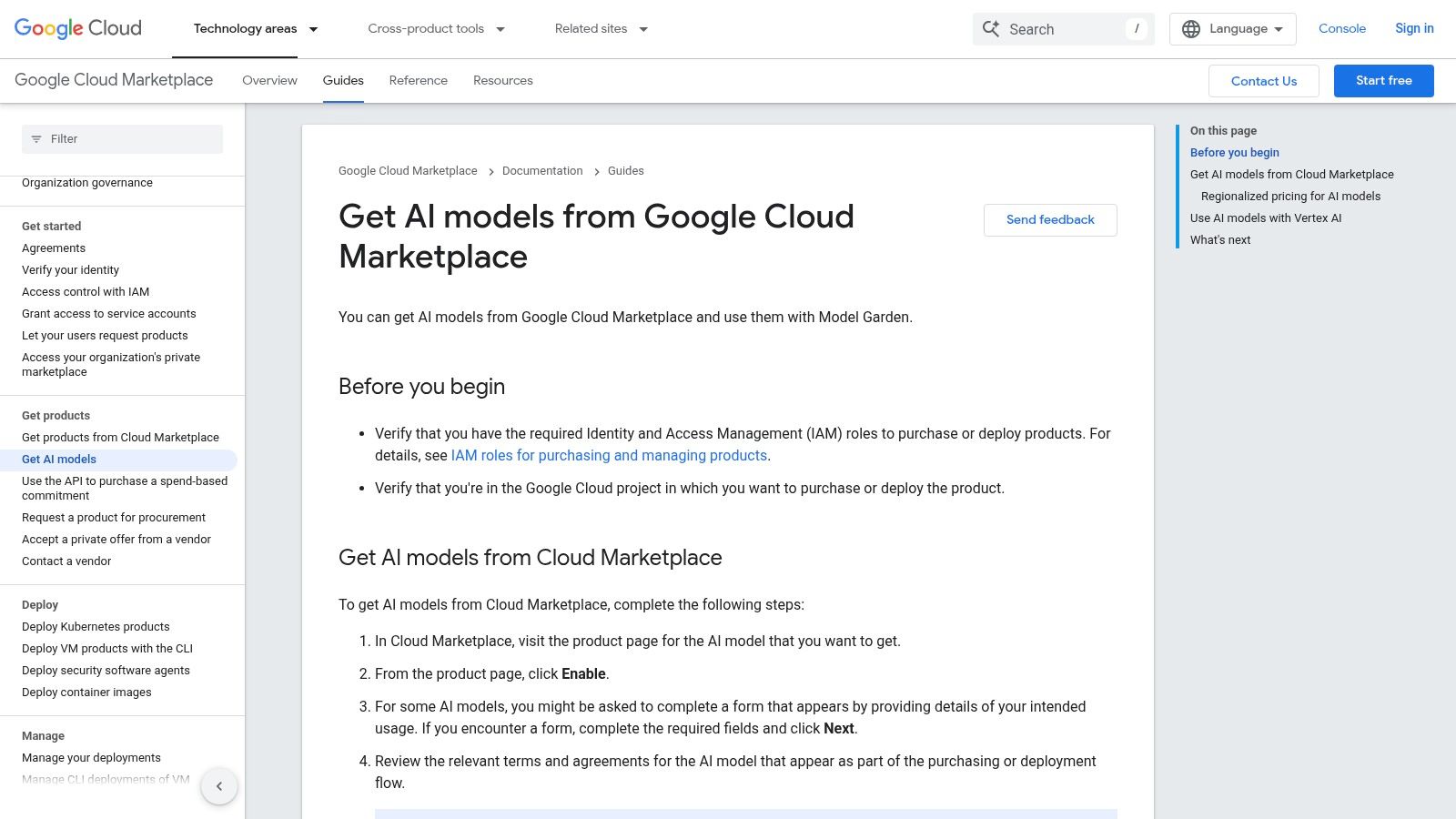
6. Google Cloud Marketplace (AI / Vertex AI Model Garden)
For teams already operating within the Google Cloud Platform (GCP) ecosystem, the Google Cloud Marketplace is the central hub for discovering, purchasing, and deploying a vast array of third-party and Google-native AI models. It acts as an enterprise-grade app store specifically for AI, allowing businesses to integrate sophisticated models directly into their existing cloud infrastructure via Vertex AI’s Model Garden. This makes it one of the most powerful ai tools for organizations requiring scalable, secure, and integrated solutions.
The platform streamlines the procurement process, enabling companies to manage billing for various AI agents and models through their existing GCP account. This consolidation is a significant advantage for IT and finance departments, as it centralizes costs and simplifies vendor management. Instead of navigating separate contracts, teams can enable models with a few clicks and immediately start building them into their workflows.
Key Features and Use Cases
- Centralized Model Discovery: Access a curated selection of foundation models for tasks like image generation, language translation, and data analysis. A telecom company could deploy a specialized language model to analyze customer feedback from support chats.
- Integrated Billing: All model subscriptions and usage-based costs are billed directly through your Google Cloud account, simplifying budget management and financial oversight for marketing and IT departments.
- Vertex AI Integration: Once a model is enabled from the Marketplace, it can be managed, fine-tuned, and deployed via Vertex AI. This allows for creating custom endpoints for specific tasks, like generating personalized ad copy for an e-commerce platform.
Pricing and Access
Pricing is model-specific and often varies by region, with options that fit different operational needs:
- Free: Many models are available to deploy at no cost, with users only paying for the underlying GCP resource consumption.
- Subscription or Usage-Based: Third-party models are often available via monthly subscriptions or on a pay-as-you-go basis, billed per request or token.
- GCP Credits: New customers can often leverage a $300 credit to experiment with various models and platform features.
Pros and Cons
- Pros:
- Tight integration with the entire Google Cloud Platform and Vertex AI.
- Simplified procurement and centralized billing for all AI models.
- Access to both Google’s proprietary models and a wide range of third-party solutions.
- Cons:
- Requires existing GCP setup and familiarity with its IAM roles and platform architecture.
- Pricing can be complex, varying by model, region, and usage patterns.
Website: https://cloud.google.com/marketplace/docs/enable-ai-models
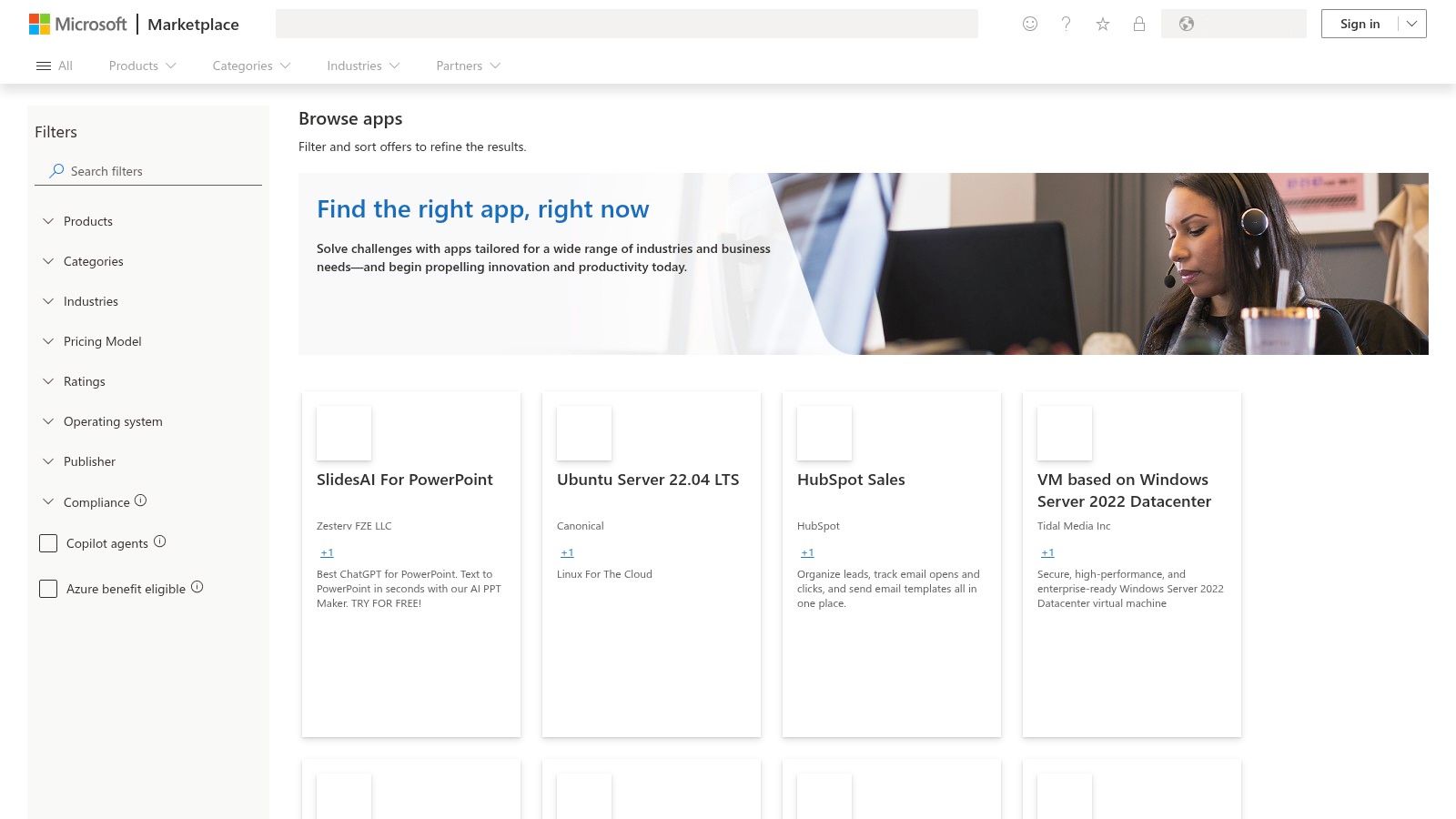
7. Microsoft Azure Marketplace (AI + Machine Learning)
For enterprises already embedded in the Microsoft ecosystem, the Azure Marketplace serves as a centralized hub for discovering and deploying a vast range of AI solutions. It’s less a single tool and more a comprehensive catalog, offering everything from foundational models like Azure OpenAI to specialized third-party SaaS applications. This makes it an ideal platform for marketing and IT teams looking to procure and manage ai tools with enterprise-grade governance and consolidated billing.
The platform’s primary strength is its integration within the broader Azure environment, enabling secure and scalable deployment of AI capabilities. Marketing teams in regulated industries like finance or insurance can find compliant solutions, while IT departments can manage access and costs through existing Azure subscriptions, streamlining the entire procurement process.
Key Features and Use Cases
- Centralized Procurement: Discover and deploy various AI applications, from MLOps platforms to cognitive services for video analysis, all through a single, trusted marketplace. This simplifies vendor management for large organizations.
- Enterprise-Ready Solutions: Access a wide variety of tools, including virtual machine images and SaaS products, that are pre-vetted for security and compatibility with Azure. A telecom company could deploy a customer service chatbot solution directly from the marketplace.
- Integrated Billing: All purchases and subscriptions are consolidated into the organization’s existing Azure bill, providing clear oversight and simplifying budget management for marketing and tech departments.
Pricing and Access
Pricing is highly variable as it is set by the individual vendors on the marketplace. Models include:
- Free and Free Trials: Many applications offer free tiers or trial periods.
- Pay-as-you-go: Billed based on usage, integrated with the Azure subscription.
- Subscription-based: Fixed monthly or annual fees for SaaS products.
- Bring Your Own License (BYOL): Use an existing license with a vendor’s Azure-based solution.
Pros and Cons
- Pros:
- Enterprise-grade procurement with robust governance and SSO.
- Vast range of solutions from infrastructure to end-user SaaS.
- Simplified billing and management for existing Azure customers.
- Cons:
- The sheer breadth of the catalog can be overwhelming to navigate.
- Pricing structures vary widely between listings and can be complex.
Website: https://azuremarketplace.microsoft.com/en-us/marketplace/apps/category/ai-plus-machine-learning
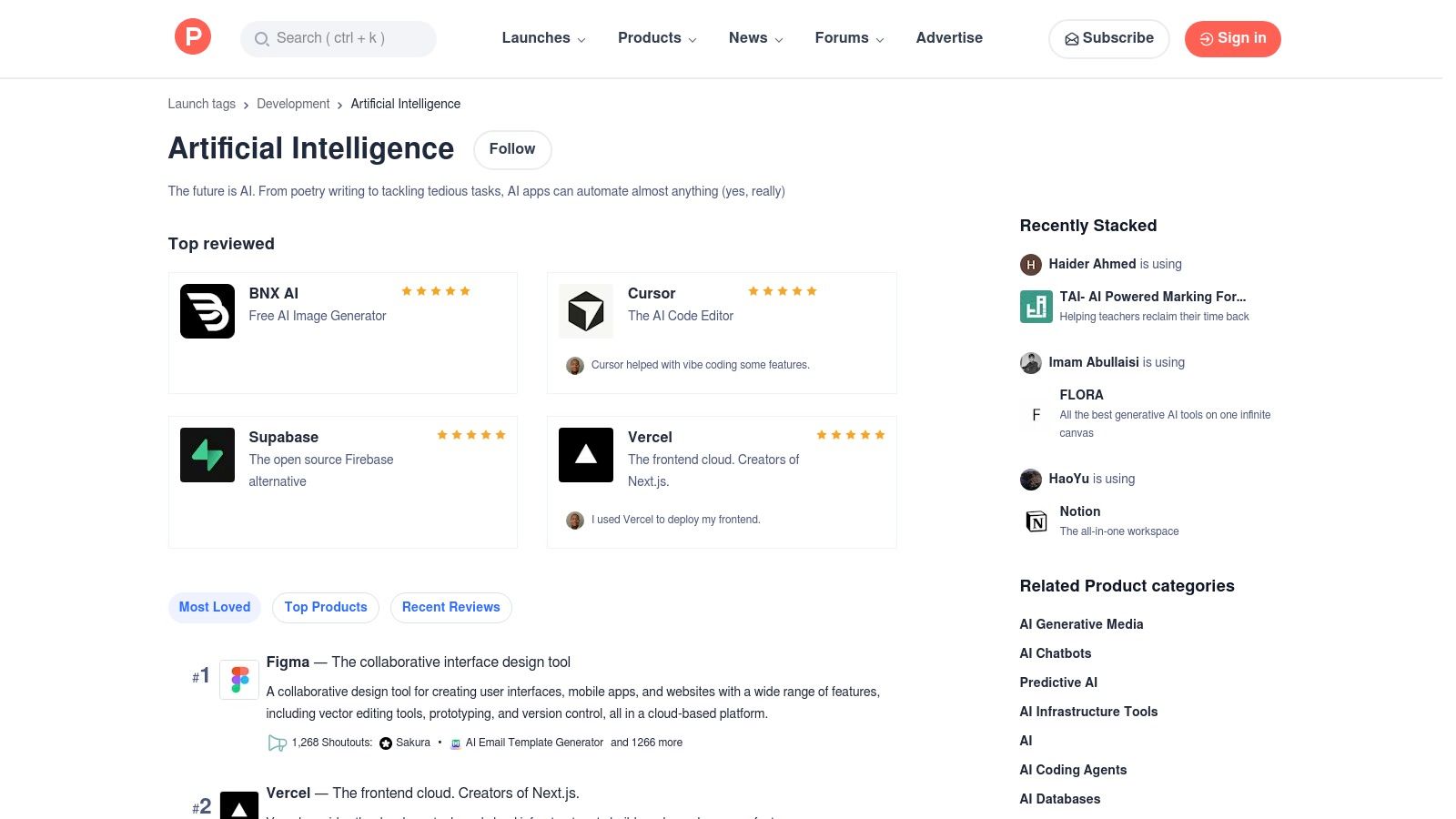
8. Product Hunt (Artificial Intelligence topic)
Product Hunt’s Artificial Intelligence topic page isn’t a single tool but rather a dynamic discovery hub for the latest AI-powered applications. For marketing and video creation teams, it serves as a crucial resource for staying ahead of the curve, offering a daily stream of new and trending ai tools directly from the makers. It allows you to gauge community sentiment through upvotes and discussions before committing to a new solution for your workflow.
The platform’s strength is its community-driven curation. Instead of relying on sponsored placements, you see what developers, marketers, and early adopters are genuinely excited about. This makes it an invaluable source for finding niche tools, such as a specialized AI voice generator for a specific accent or an image editor with a unique generative fill capability that could enhance video assets.
Key Features and Use Cases
- Discover Emerging Tools: Marketing agencies can monitor the “Product of the Day” to find innovative tools for campaign automation or content creation, gaining a competitive edge.
- Community Validation: Before adopting a new AI scriptwriter, a team can review the comments and upvotes to see real user feedback, potential bugs, and creative use cases.
- Niche Solution Sourcing: A non-profit could find a newly launched, cost-effective AI tool for grant writing, or an e-commerce brand could discover a specialized app for generating product descriptions.
Pricing and Access
Product Hunt is a discovery platform, not a retailer, so access and pricing are determined by the individual products listed.
- Free to browse: Accessing the website, viewing listings, and reading comments is completely free.
- Product Pricing Varies: Each listed tool has its own pricing model, ranging from free and freemium to subscription-based or one-time purchases.
Pros and Cons
- Pros:
- Excellent for discovering brand-new and innovative AI tools daily.
- Community feedback provides authentic, unfiltered insights.
- Filters help identify products with real momentum.
- Cons:
- Quality and long-term viability of listed products can vary significantly.
- Many tools are in early-stage development and may lack robust support.
Website: https://www.producthunt.com/topics/artificial-intelligence
9. G2 (Artificial Intelligence category)
G2 is not an AI tool itself but an essential B2B software marketplace where businesses can discover, review, and compare the best ai tools for their specific needs. For marketing and video creation teams, G2’s Artificial Intelligence category serves as a vital research hub, offering verified user reviews, detailed leader grids, and comprehensive buyer guides. It cuts through the marketing noise to provide peer-validated insights into which platforms deliver on their promises.
The platform’s value lies in its structured and trusted data. Instead of relying on vendor websites alone, teams can filter through hundreds of AI solutions based on company size, specific features, and user satisfaction ratings. This allows a marketing agency, for example, to quickly find top-rated AI video generators that integrate with their existing project management software, backed by reviews from similar-sized agencies.
Key Features and Use Cases
- Category Rankings and Leader Grids: Use G2 Grids to visually compare top-performing AI software in categories like “Text to Speech” or “AI Video Generation.” This helps teams quickly shortlist vendors based on market presence and customer satisfaction.
- Verified User Reviews: Read in-depth reviews from real users to understand the practical strengths and weaknesses of a tool. An insurance company could check reviews for an AI copywriting tool to see how well it handles compliance-heavy content.
- Robust Filtering: Narrow down options by essential criteria such as business scale (SMB vs. Enterprise), specific features, and integration capabilities. This ensures you only evaluate tools that fit your existing workflow.
Pricing and Access
G2 itself is free to use for research and reviews. The pricing information for the listed AI tools varies by vendor:
- Free: Access to all of G2’s reviews, comparison tools, and buyer guides is completely free.
- Vendor Pricing: Each software listing provides information on the vendor’s pricing model, though some may require direct contact for a quote.
Pros and Cons
- Pros:
- Massive database of verified, trustworthy user reviews.
- Excellent filtering and comparison tools to find the right solution.
- Taxonomy is well-aligned with emerging AI software segments.
- Cons:
- Not all listings provide transparent, public pricing.
- Accessing some vendor reports or content may require lead-generation form submissions.
Website: https://www.g2.com/categories/artificial-intelligence
10. Capterra (Artificial Intelligence Software)
Capterra serves as a comprehensive software directory, offering a dedicated space for businesses to discover and compare a wide range of ai tools. Instead of being a single tool itself, it functions as a critical research hub for marketing and video creation teams looking to find the perfect software solution for their specific needs, from video generators to automation platforms. It simplifies the complex process of vendor selection by aggregating user reviews, feature lists, and pricing information.
The platform’s value lies in its structured comparison framework and extensive filters, which allow teams to narrow down options based on specific functionalities, business size, and deployment types. For a marketing agency comparing different AI-powered analytics tools, Capterra provides a neutral ground to evaluate features side-by-side, read authentic user feedback, and create a shortlist of vendors to contact for demos.
Key Features and Use Cases
- Software Comparison: Use the platform to directly compare features of multiple AI video editors or scriptwriting assistants. An e-commerce team could filter for tools that integrate with Shopify and compare their user ratings and core features.
- User Review Analysis: Leverage authentic, verified user reviews to understand the real-world performance and support quality of various AI platforms before committing to a subscription.
- Buyer Guides and Research: Access detailed buyer guides and articles that explain different categories of AI software, helping teams make more informed purchasing decisions.
Pricing and Access
Capterra is a free-to-use resource for software buyers. The platform makes money from software vendors who pay for placement and lead generation. This means users can browse, compare, and read reviews without any cost.
Pros and Cons
- Pros:
- Offers clear, side-by-side comparisons and shortlisting tools.
- Strong reputation as a neutral and extensive software marketplace.
- Relies on verified user reviews for authentic insights.
- Cons:
- Pricing information can be incomplete as it relies on vendor disclosure.
- Promoted vendor listings can influence visibility on category pages.
Website: https://www.capterra.com/artificial-intelligence-software/
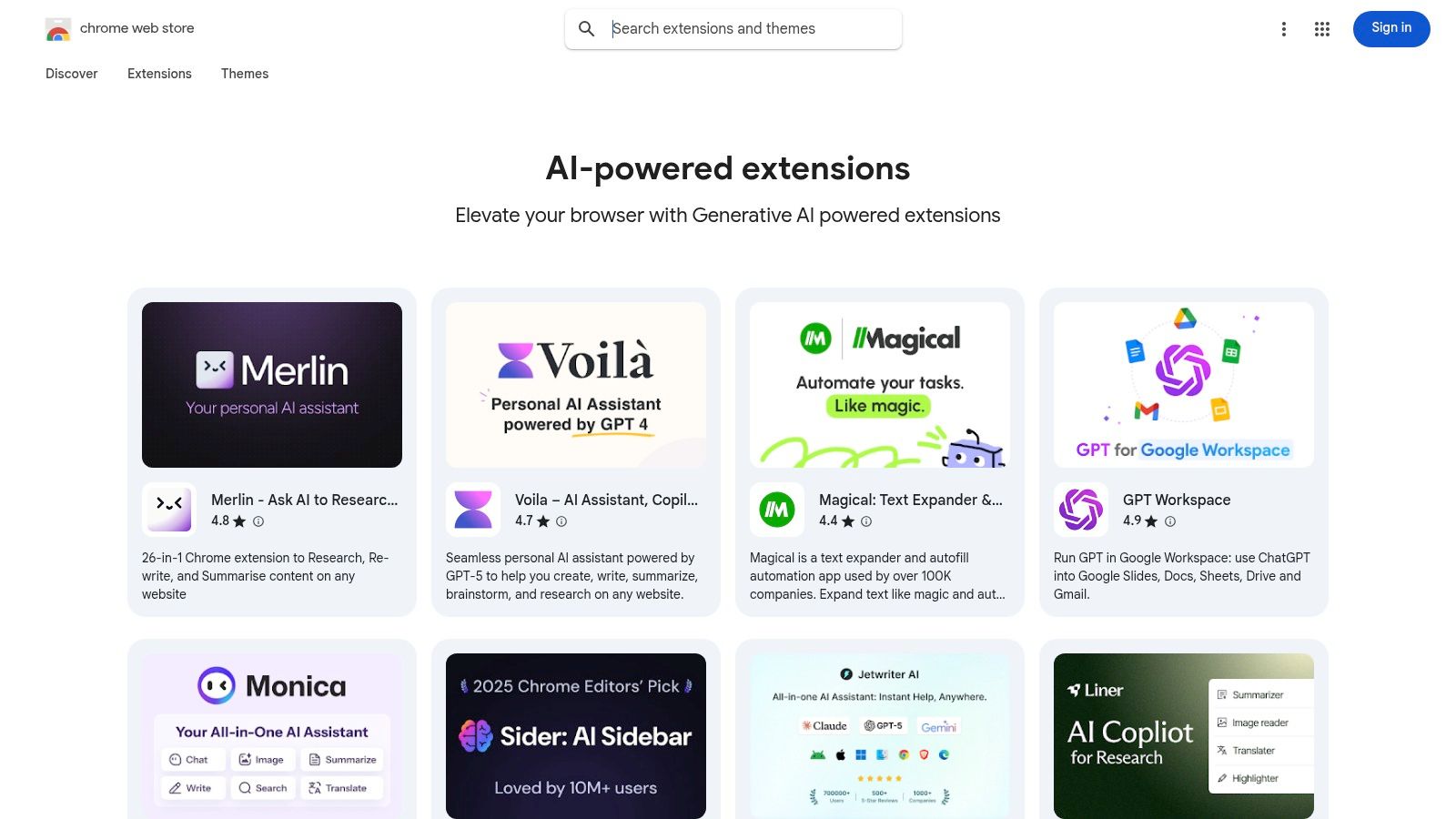
11. Chrome Web Store (AI extensions collections)
The Chrome Web Store isn’t a single tool but a curated gateway to hundreds of AI-powered browser extensions. For marketing teams and content creators, this is an invaluable resource for adding specific AI capabilities directly into their existing workflows. Instead of switching between multiple tabs and applications, you can find lightweight, task-specific ai tools for summarizing articles, enhancing writing, or generating quick content ideas without leaving your browser.
Google’s curated collections, like ‘gen_ai_extensions’, make it easy to discover and vet popular tools. This approach allows for rapid experimentation, letting you install and test different AI assistants to see which best fits your needs for drafting social media updates, analyzing competitor websites, or refining email campaign copy on the fly.
Key Features and Use Cases
- Curated AI Collections: Browse dedicated categories for generative AI and productivity to quickly find relevant tools. For example, a marketing agency can find extensions that summarize long-form articles for research or suggest email subject lines directly within Gmail.
- Ratings and Permission Transparency: Each extension listing includes user reviews, update history, and a clear breakdown of the data permissions it requires. This helps teams make informed decisions about security and reliability before installation.
- Easy Installation and Management: Extensions can be added or removed with a single click, encouraging a low-risk environment for trying new tools. A non-profit could test several grammar and tone assistants to find the best one for writing compelling donation appeals.
Pricing and Access
Access to the Chrome Web Store and its collections is free. The pricing of individual extensions varies widely:
- Free: Many extensions offer core features for free.
- Freemium: Basic functionality is free, with premium features available through a subscription.
- Paid: Some specialized extensions require a one-time purchase or a recurring subscription.
Pros and Cons
- Pros:
- A quick and easy way to try many AI tools directly in the browser.
- Ideal for lightweight, task-specific functions like summarization and writing aids.
- Integrates AI capabilities into existing web applications and workflows.
- Cons:
- The quality and trustworthiness of extensions can vary significantly.
- Users must carefully review permissions and developer reputations to avoid privacy risks.
Website: https://chromewebstore.google.com/collection/gen_ai_extensions
12. OpenRouter
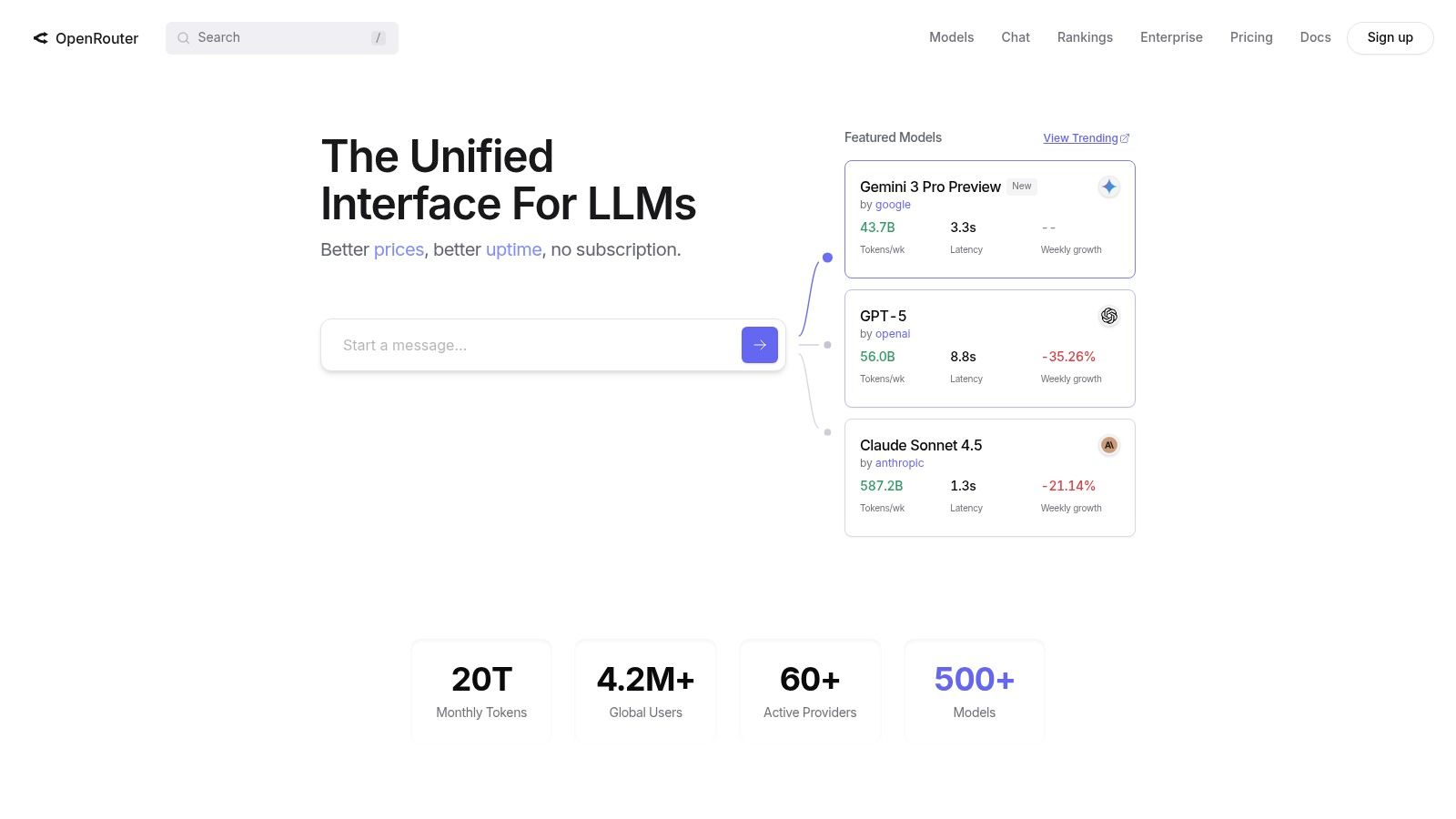
OpenRouter serves as a universal gateway to a vast array of AI models from different providers like OpenAI, Anthropic, Google, and Mistral. For marketing teams and developers, it centralizes access and billing, allowing them to experiment with or switch between models without managing multiple accounts and APIs. This makes it one of the most flexible ai tools for finding the perfect model for a specific task, whether it’s drafting ad copy, generating video script ideas, or analyzing customer feedback.
The platform’s power lies in its unified, pay-as-you-go credit system. Instead of committing to a subscription with one provider, a team can purchase credits on OpenRouter and use them across dozens of models, only paying for what they use. This approach simplifies budget management and removes vendor lock-in, enabling a more agile and cost-effective AI strategy.
Key Features and Use Cases
- Multi-Provider Access: Use a single API key to access models from leading providers. A marketing agency could test a campaign slogan on Google’s Gemini, Meta’s Llama, and Anthropic’s Claude simultaneously to compare outputs.
- Cost Optimization: Compare transparent, per-token pricing for all available models to choose the most cost-effective option for any given task. For example, use a cheaper model for simple text summarization and a more powerful one for complex scriptwriting.
- Model Evaluation: Easily benchmark different models for specific use cases. An IT marketing team can run the same technical brief through several models to see which one produces the most accurate and readable content for a product one-pager.
Pricing and Access
OpenRouter operates on a prepaid, credit-based system:
- Pay-As-You-Go: Users purchase credits and consume them based on the specific pricing of the models they use.
- Transparent Token Pricing: The platform provides a clear, public list of the cost per million input and output tokens for every model, making it easy to estimate expenses.
Pros and Cons
- Pros:
- Centralizes billing and access for hundreds of AI models.
- Helps avoid vendor lock-in and simplifies API management.
- Competitive, pass-through pricing on many popular models.
- Cons:
- Model availability and pricing can change over time.
- Minimum credit purchase amounts or top-up fees may apply.
Website: https://openrouter.ai
12 AI Tools: Side-by-Side Comparison
| Product | Core offering | Key features | Target audience | Pricing & plans | Unique selling point |
|---|---|---|---|---|---|
| Wideo (Recommended) | Cloud no-code animated video platform | Drag‑and‑drop editor, 100s templates, AI voice/avatars, blog‑to‑video, MP4 export, social share | Marketers, SMEs, agencies, enterprise video teams | Free trial; scalable individual, team & enterprise plans (quote for advanced automation) | Fast, affordable no‑code video + AI personalization + Chromebook optimization |
| OpenAI | AI assistant & multimodal platform | ChatGPT tiers, custom GPTs, voice/image/file support, GPT Store | Developers, businesses, consumers | Free; Plus $20/mo; Pro $200/mo; Business $25/user/mo; Enterprise by quote | Broad multimodal capabilities and custom GPT ecosystem |
| Anthropic (Claude) | High‑reasoning AI assistant | Claude Pro, long‑context support, coding and reasoning focus | Teams needing reasoning, research, long‑context tasks | Pro monthly/annual subscriptions; regional variations | Competitive pricing for high‑end reasoning and long contexts |
| Hugging Face | Open model hub & deployment platform | Model Hub, Spaces, Inference Endpoints, pay‑as‑you‑go infra | Developers, ML teams, researchers | Per‑instance/hour inference pricing, storage tiers, credits | Massive model catalog and transparent infra pricing |
| AWS Marketplace (ML) | Curated ML models & SaaS for AWS | Pre‑trained models, one‑click SageMaker deploy, usage billing | Enterprise procurement, AWS users, data teams | Usage‑based pricing; consolidated AWS billing; private offers | Deep AWS integration and enterprise procurement controls |
| Google Cloud Marketplace (Vertex AI) | Models & agents for Vertex AI | Enable models to Vertex AI, regional endpoints, subscription/usage billing | GCP users, enterprise ML teams | GCP billing; regionalized pricing; $300 credit for new customers | Tight Vertex AI integration and GCP ecosystem benefits |
| Microsoft Azure Marketplace | AI + ML catalog for Azure | SaaS, VM images, MLOps tools, Azure OpenAI listings | Azure customers, enterprises, procurement teams | Per‑listing pricing; Azure billing and governance | Enterprise controls, SSO and broad solution range |
| Product Hunt (AI) | Discovery hub for new AI products | Daily launches, votes, comments, outbound links | Founders, early adopters, product hunters | Free to browse and post | Fast way to spot trending AI startups and community sentiment |
| G2 (AI category) | B2B software reviews & comparisons | Verified reviews, leader grids, buyer guides, filters | Buyers, procurement teams, SMBs/enterprises | Free browse; vendor contact/lead generation possible | Large verified review base and vendor rankings |
| Capterra (AI) | Software directory and buyer guides | Category overviews, reviews, shortlisting tools | SMBs, buyers comparing vendors | Free browse; vendor‑provided pricing ranges | Clear side‑by‑side comparisons and buyer guidance |
| Chrome Web Store (AI extensions) | Browser extensions marketplace | Curated AI extension collections, ratings, permissions | End users, productivity seekers | Mostly free; some paid extensions or subscriptions | Quick, lightweight AI features directly in the browser |
| OpenRouter | Multi‑model API marketplace | Unified access to many models, credit‑based billing, per‑model pricing | Developers evaluating or mixing models | Prepaid credits, pay‑as‑you‑go per model | Centralized multi‑provider access to avoid vendor lock‑in |
Building Your AI-Powered Video Stack for Maximum Impact
The landscape of AI tools has exploded, offering unprecedented opportunities to innovate, automate, and scale your video marketing efforts. We’ve navigated a broad spectrum of resources, from the foundational LLMs offered by OpenAI and Anthropic to the expansive cloud marketplaces of AWS, Google, and Microsoft Azure. We’ve also explored discovery platforms like Product Hunt and G2, which are essential for staying current in this rapidly evolving ecosystem.
The central insight is clear: the future of high-impact video marketing isn’t about finding a single, magical AI tool. Instead, success lies in strategically assembling a bespoke “AI stack” where each component addresses a specific stage of your workflow. This modular approach allows you to build a powerful, end-to-end system tailored to your unique goals, whether you’re a marketing agency personalizing client campaigns or an HR department scaling corporate training videos.
Your Blueprint for Assembling an Effective AI Toolkit
Moving from theory to practice requires a clear strategy. Start by auditing your existing video creation process to identify bottlenecks and opportunities for AI intervention. Where do you spend the most time? Is it scripting, asset creation, voiceover recording, or final editing and distribution? Answering these questions will illuminate which category of AI tools will deliver the most immediate return on investment.
Consider these practical steps as you begin building your stack:
- Foundation First: Begin with a core video creation platform like Wideo, which integrates AI features for scripting and text-to-speech. This provides a central hub to anchor your workflow.
- Ideation and Scripting: Augment your core platform with a powerful large language model. Use OpenAI’s ChatGPT or Anthropic’s Claude for brainstorming campaign concepts, generating script variations for A/B testing, or refining copy for different target audiences, like fintech marketers or non-profit donors.
- Asset and Data Integration: Leverage tools from cloud marketplaces (AWS, Google, Azure) to handle more complex tasks. For instance, an insurance company could use a model from the AWS Marketplace to analyze claims data and then feed key insights into a script generator for personalized explainer videos.
- Discovery and Experimentation: Keep an eye on discovery platforms like Product Hunt and G2. These are invaluable for finding niche AI tools that can solve very specific problems, such as generating unique background music or creating hyper-realistic avatars for your training modules. For specialized needs, such as scaling your paid campaigns, exploring a dedicated AI video generator for ads can automate the creation of hundreds of ad variations, a task that would be impossible to manage manually.
- Workflow Automation: Use API aggregators like OpenRouter to experiment with different models without committing to a single provider. This allows you to dynamically choose the best model for a specific task, optimizing for both cost and performance as you scale your video output.
The Strategic Imperative: Beyond Efficiency to Innovation
Ultimately, integrating these AI tools is about more than just saving time or reducing costs. It’s a strategic shift that empowers your team to operate at a higher level. When AI handles the repetitive and time-consuming tasks, your creative professionals are free to focus on what truly matters: strategy, storytelling, and building authentic connections with your audience.
The true power of this AI-driven approach is its ability to unlock personalization at scale. A travel marketer can now create hundreds of video variations targeting different destinations and demographics, while a car dealership can generate personalized video walkthroughs for every vehicle in its inventory. This level of customization was once prohibitively expensive and complex, but with the right stack of AI tools, it is now within reach for teams of any size. The journey begins with that first step: choosing your foundational tools and building from there.
Ready to build the foundation of your AI-powered video strategy? Wideo combines an intuitive video editor with powerful AI features, allowing you to generate scripts, create professional voiceovers, and produce stunning videos in minutes. Start creating with Wideo today and see how easy it is to bring your ideas to life.