

Sound familiar? Imagine your entire sales team finishes a new product training. High fives all around. But then, quarterly sales numbers barely budge. This is the classic—and maddening—gap between training activity and real-world business impact.
The truth is, completion rates don’t mean much. They don’t tell you if anyone learned anything, if behaviors changed, or if the business is any better for it. It’s time to stop measuring what’s easy and start measuring what matters.
Moving Beyond Completion Rates to Real Impact

Let’s get practical. The real measure of a training program isn’t found in a dashboard showing who clicked “complete.” It’s found on the factory floor, on sales calls, and in customer support tickets.
True effectiveness is measured in observable behavior change, on-the-job skill application, and—most importantly—tangible business outcomes. It’s about connecting the dots between what people learn and how the company performs.
This is where L&D transforms from a cost center into a strategic partner. Instead of just reporting on attendance, you start demonstrating how your initiatives directly influence the metrics your CEO actually cares about.
Shifting Your Measurement Mindset
The first step is a mental one. We have to redefine what “success” even looks like for a training program. It’s not about checking a box; it’s about driving genuine, measurable improvement in how people do their jobs.
This means moving away from the superficial metrics we’ve relied on for decades and adopting a modern approach that tells a story of growth and performance.
To make this crystal clear, here’s a look at the paradigm shift from outdated, vanity metrics to the modern, impactful ones you should be tracking.
| Focus Area | Outdated Metric (What to Avoid) | Modern Metric (What to Track) |
|---|---|---|
| Knowledge | Course Completion Rate | Pre- vs. Post-Assessment Scores |
| Application | Hours Spent in Training | Observed On-the-Job Behavior Change |
| Satisfaction | “Smile Sheets” (General Feedback) | Employee Relevance & Impact Surveys |
| Engagement | Number of Attendees | Video Re-watch Rates, Participation |
| Business Value | Training Budget Adherence | Productivity Gains, Reduced Errors |
See the difference? We’re moving from counting attendees to measuring skill acquisition. From tracking hours to observing real-world application.
When you start focusing on these modern metrics, the conversation changes entirely. You’re no longer justifying your budget; you’re building a powerful, data-backed case for how continuous learning fuels the entire organization. You can finally show, with confidence, how your programs contribute to everything from sales lift to higher customer satisfaction scores.
A Modern Framework for Evaluating Training Success
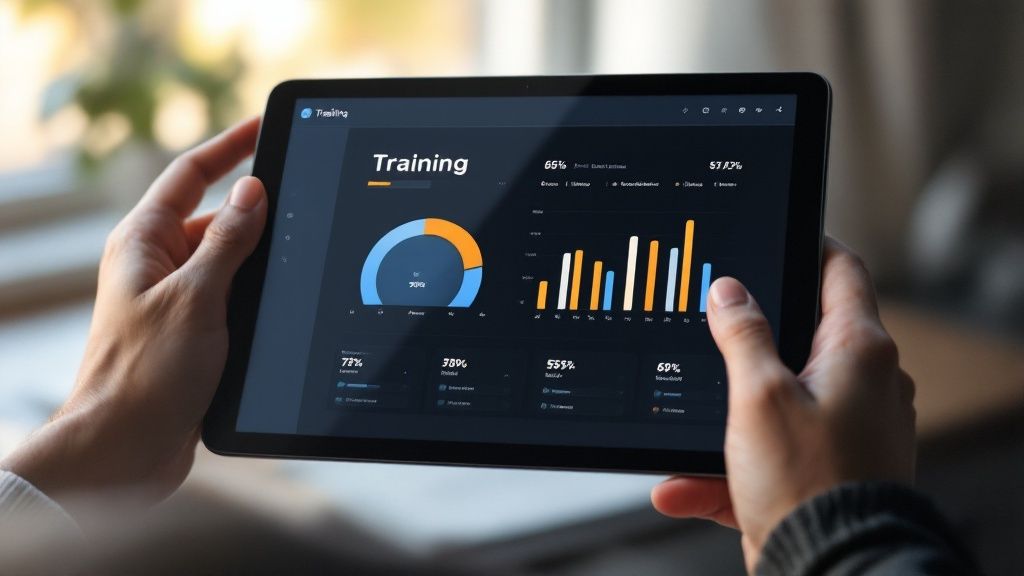
To really know if your training is working, you need to look at its impact from every angle. A modern approach starts by getting crystal clear on what you want people to do differently after the training. This means understanding learner outcomes versus objectives is the critical first step. Once you know your target, you can build a measurement strategy that tells the full story.
For decades, the gold standard has been the Kirkpatrick Four-Level Training Evaluation Model. It’s a classic for a reason. This framework gives you a systematic way to measure success across four distinct levels: Reaction, Learning, Behavior, and Results.
It’s not just theory, either. When organizations actually apply all four levels, some have seen up to a 20% improvement in key performance metrics.
Let’s walk through how to put this model into practice with a modern, no-nonsense approach.
Level 1: Reaction
This is your gut check. Did the training actually land with your team? We’re not just fishing for compliments here; we’re trying to figure out if they found it relevant and valuable.
You have to go beyond the generic “Did you enjoy the session?” questions. Get specific in your post-training surveys:
- “On a scale of 1-10, how relevant was this content to your daily work?”
- “What’s one thing you plan to apply in the next 30 days?”
- “Did the format (e.g., live webinar, video module) help or hurt your learning?”
This early feedback is priceless. If learners can’t connect with the material right away, it’s a safe bet they won’t absorb it, let alone use it.
Level 2: Learning
Okay, they liked it. But did they actually learn anything? This is where we move from opinions to hard data and confirm that knowledge was actually transferred.
Here are a few effective ways to measure this:
- Pre- and Post-Training Assessments: This is the best way to get concrete proof. A big jump in scores from the pre-test to the post-test is undeniable evidence of learning.
- Skill-Based Simulations: For hands-on skills, put them to the test. Can a support agent who just finished training correctly resolve a mock customer ticket?
- Confidence Ratings: It’s simple but powerful. Ask employees to rate their confidence in a skill before and after training. Seeing someone go from “Unsure” to “Confident” is a fantastic indicator.
Level 3: Behavior
This is where the rubber meets the road. Are people actually using what they learned back on the job? Behavior change is the crucial link between learning something in a session and seeing a real business result.
Catching this change in action means looking outside the training room.
- Manager Observations: Give managers simple checklists to spot new behaviors during one-on-ones or team meetings.
- Peer Feedback: A 360-degree feedback loop can be great. Colleagues can comment on whether they’ve seen a teammate apply new skills, like better communication in meetings.
- KPI Monitoring: Keep an eye on metrics tied directly to the training. After a time management workshop, for example, you’d want to see a drop in missed deadlines.
Key Takeaway: Real behavior change takes time. You need to give people a chance to apply their new skills. Plan to measure this level 30 to 90 days after the training wraps up.
Level 4: Results
Finally, the bottom line. This is where we connect the dots between your training program and tangible business outcomes. It’s the level that gets leaders to sit up, take notice, and keep investing in your L&D programs.
This means analyzing the high-level metrics your training was meant to impact. Did that new sales training actually lead to a bump in quarterly revenue? Did the revamped safety training result in fewer workplace accidents?
Answering these questions proves your training isn’t just an expense—it’s a strategic investment in the company’s future.
Gathering Data That Actually Tells a Story

Measuring training effectiveness isn’t a one-and-done deal; it’s a continuous process of gathering real-world insights. Once you have a solid framework, the real work begins: collecting meaningful data that goes way beyond that predictable post-training survey. The goal is to build a rich, multi-dimensional picture of your training’s impact over time.
This means shifting from a snapshot approach to something more like an ongoing conversation with your learners and their managers. Instead of just asking, “Did you like it?” right after a session, we need to start asking, “Is it working?” weeks or even months down the line.
Weave Feedback into the Workflow
Let’s be honest, the traditional survey often feels like a chore. A much better approach is to integrate data collection right into the employee experience, making it feel less like a test and more like a useful part of the job.
- Pulse Surveys: Ditch the one-time, monster survey. Instead, send out short, targeted “pulse” surveys via Slack or email. A quick two-question poll a month after training can reveal more about long-term application than a 20-question form sent on the day.
- Manager Check-ins: Equip managers with simple, structured questions to ask during their regular one-on-ones. Something as simple as, “I know you completed the project management training last month. Can you show me how you’re using the new planning template?” works wonders.
- Engagement Metrics: Monitor how employees interact with training materials. Are they spending significant time on certain modules? Are they actively participating in discussions? These are strong indicators of relevance.
Modern organizations are moving away from stale surveys and toward continuous, real-time feedback. Industry reports suggest that companies using this approach see learner retention rates improve by 15-25% and notice faster skill acquisition.
Combine Quantitative and Qualitative Insights
The most powerful stories are told with both numbers and narratives. To truly understand if your training is hitting the mark, you need to look at the data and the people behind it.
Quantitative Data (The “What”):
- Pre- and post-assessment scores
- Skill application rates on the job
- Changes in team KPIs (e.g., sales numbers, error rates)
- Video engagement metrics (watch time, completion rates)
Qualitative Data (The “Why”):
- Employee Stories: Ask employees to share a specific instance where the training helped them solve a problem. These testimonials are incredibly powerful for demonstrating value to leadership.
- Manager Observations: A manager’s note that a team member is now leading meetings more confidently after a communication workshop is a fantastic qualitative metric.
- Focus Groups: Gather a small group of trainees to discuss what worked, what didn’t, and what roadblocks they hit when trying to apply their new knowledge back on the job.
By blending these two types of data, you move from just reporting numbers to telling a compelling story about how your training is shaping performance and culture. For example, when you’re looking at video-based learning, digging into specific online video metrics can give you the quantitative proof to back up qualitative feedback on whether the content was clear and engaging. This dual approach gives leaders the context they need to see the real value of your L&D initiatives.
Connecting Your Training Investment to Business ROI

You’ve measured reactions, gauged learning, and tracked behavior. Now comes the question every executive asks: “What did we get back?” To answer, you need to translate those training results into crisp financial terms that speak directly to the C-suite. A data dashboard or powerful reporting tool can be invaluable here, visualizing the connection between learning activities and business outcomes.
To do this effectively, you need to isolate the impact of your training. Before you can calculate ROI, you have to prove the boost in performance came from your program and not from other factors—say, a marketing push or seasonal demand.
Proving the Link Between Training and Results
Isolating impact is the key to credibility. Here are a few solid methods:
- Control Groups: Match a group that received training against a similar, untrained team. The performance delta is your direct training effect.
- Trend Line Analysis: Chart key metrics before and after training. A sustained uptick right after rollout makes a compelling case.
- Manager & Participant Estimates: Have managers and staff put a percentage on how much their gains came from training. Averaging these figures adds credibility.
Assigning Monetary Value to Outcomes
The next step is to turn performance changes into dollars:
- Increased Sales: A 5% lift in a sales team’s close rate? Multiply that by average deal size to find new revenue.
- Reduced Errors: A 10% drop in production mistakes means fewer scrap materials and less rework. Tally the before-and-after cost per unit.
- Productivity Gains: When tasks take 15% less time, translate saved hours into salary cost savings.
The ROI Calculation
Once benefits are in dollar terms and you’ve isolated training’s share, plug into this formula:
ROI (%) = (Net Program Benefits / Total Program Costs) × 100
Net Program Benefits equals total monetary gain minus what you spent. The resulting percentage shows how much value you generated for every dollar invested.
Key Takeaway: Presenting a strong ROI shifts the conversation from “Can we afford this?” to “How soon can we expand it?”
For more in-depth tactics, explore our guides on calculating the return on investment for your projects. You’re not just requesting funds—you’re crafting a data-driven roadmap for growth.
Using Video to Boost and Measure Learning
Let’s be honest: static presentations and dense training manuals are where employee engagement goes to die. In today’s world, video is an absolute powerhouse for both delivering and measuring modern learning, offering a dynamic way to connect with employees and capture rich, actionable data on how they’re progressing.
Think about it from your team’s perspective. Would they rather scroll through a 50-page PDF or watch a few short, engaging videos? The video format is far more likely to hold their attention, which directly translates to better knowledge retention. It also delivers a consistent, scalable learning experience for everyone, whether they’re in the main office or working from home.
Modern Formats for Modern Learners
The trick is to move beyond just recording hour-long webinars and calling it a day. The real impact comes from creating purpose-built video content that solves specific learning challenges.
- Microlearning Clips: These are your secret weapon. Short, focused videos—usually 2-5 minutes long—that teach a single skill or concept. They’re perfect for reinforcing knowledge and can be deployed on demand whenever an employee needs a quick refresher.
- Scenario-Based Training: This is where learning gets real. Interactive videos can drop an employee into a realistic workplace scenario, like handling a tricky customer complaint. They’re prompted to make a decision and then see the direct consequences of their choice. It’s active learning, not passive viewing.
- Animated Explainer Videos: Got a complex process or a dry-but-important topic to cover? Animation is your best friend. It simplifies things like data privacy policies or new software workflows, making them much easier for people to digest and actually remember.
As you can see, modern platforms empower HR and L&D teams to create professional-quality animated videos without needing a background in design. This visual approach is fantastic for breaking down complicated information into memorable, bite-sized pieces that truly resonate.
Unlocking Granular Measurement Data
Now for the best part. This is where video becomes a total game-changer for measuring training effectiveness. Unlike a simple PDF download or a live webinar, video platforms provide a treasure trove of data that reveals exactly how employees are engaging with the material.
You can track watch times to see if people are even finishing the content, pinpoint specific segments that are being re-watched (a huge red flag for confusion or complexity), and measure interaction with elements like in-video quizzes.
This kind of granular insight tells a much deeper story than a simple completion rate ever could. Imagine you see that 75% of your sales team re-watched the section on objection handling three times. Boom. You’ve just identified a critical gap that needs immediate follow-up coaching. This data lets you stop guessing and start refining your content for better outcomes.
For teams ready to put this strategy into action, an intuitive platform is everything. Investing in the right training video software helps HR and L&D pros create and personalize these videos at scale, turning what could be a complex process into a manageable one. And if you want to dive deeper into production strategies, there are some great insights on creating video training that actually sells.
By bringing video into your training mix, you’re not just improving the learning experience—you’re gaining a powerful diagnostic tool to continuously prove your program’s impact on employee growth.
Common Questions About Training Measurement
Even with a solid framework, a few questions always seem to pop up once you get into the weeds of measuring training effectiveness. Let’s tackle some of the ones I hear most often from L&D pros.
What Is the Most Important Metric for Training Effectiveness?
This is the million-dollar question, but there’s no single “most important” metric. The best ones are always tied directly to your specific goals.
While everyone loves seeing those big Level 4 (Business Impact) metrics like a jump in sales or a drop in costs, I’ve found that Level 3 (Behavior Change) is often the most critical leading indicator.
Think of it this way: if your team isn’t actually applying their new skills on the job, you’ll never see the business impact you’re hoping for. That’s why I always tell people to focus on observing and measuring the on-the-job application of new skills. It’s your first real sign of success.
How Can I Measure the Effectiveness of Soft Skills Training?
Measuring soft skills like communication or leadership can feel a bit like nailing jello to a wall, but it’s absolutely doable. The trick is to stop looking for one perfect method and instead use a multi-pronged approach to get a complete picture.
Here’s what works well in practice:
- Pre- and Post-Training Self-Assessments: Ask employees to rate their own confidence and competence before and after the training. This gives you a baseline for perceived growth.
- 360-Degree Feedback: Gather input from peers, direct reports, and managers. They’re the ones who will notice observable changes in day-to-day behavior.
- Scenario-Based Assessments: Put learners in simulated workplace situations and see how they respond. This is a great way to test application in a controlled setting.
- Track Related KPIs: Look for movement in related business metrics. Did customer complaints drop after that communication training? Did team engagement scores go up after the leadership development program?
The key is triangulation. When self-assessments, peer feedback, and business KPIs all point toward improvement, you have a powerful story to tell about the training’s success.
How Soon After Training Should I Measure Its Impact?
Effective measurement is a marathon, not a sprint. You need to assess the impact at different intervals to see the full story of how learning actually translates into performance over time.
A good timeline usually looks something like this:
- Immediately After: This is your chance to measure Level 1 (Reaction). A quick post-session survey can capture initial impressions and whether the content felt relevant.
- Within 1-2 Weeks: Time to check Level 2 (Learning). A simple knowledge check or skill assessment will tell you if the information actually stuck.
- 30-90 Days Later: Now you’re looking for Level 3 (Behavior). This is when you can use manager observations and KPI tracking to see if people are applying what they’ve learned. You have to give them enough time to put it into practice.
- 3-6 Months Later (or longer): Finally, it’s time for Level 4 (Results). This is where you can start to see the full impact on broader business outcomes.
By planning your measurement at these different points, you move beyond a simple snapshot and start building a comprehensive view of your training program’s lasting value.
Ready to create compelling, scalable video training that gets results? Wideo’s intuitive platform helps HR and L&D teams produce professional animated videos and presentations in minutes. Automate and personalize your training at scale by exploring our HR and training video solution.
Related posts:
 How to use Video Marketing on LinkedIn (Upload Native Videos!)
 How to set up a Facebook Cover Video
 How to use YouTube video ads to drive conversions
 Savvy Tips to Create Engaging Marketing Content
 The ultimate (ever-growing) list of content marketing video tools and resources for 2021
 How to create a Personalized Video