

Your idea is brilliant. Your product is a game-changer. But when you try to explain it, you see that familiar glazed-over look. There’s a massive gap between your vision and what your audience actually understands. That’s the clarity gap—and it’s the silent killer of conversions.
This is where the strategic power of explainer video creation comes in. It’s not about making a flashy ad; it’s about closing that gap. It’s about turning complexity into comprehension and transforming confused prospects into confident buyers. A great explainer video doesn’t just show what you do; it makes your audience feel the relief of their problem being solved.
Why Your Business Needs a Clarity Strategy, Not Just a Video

Let’s be honest. Potential customers don’t care about your groundbreaking algorithm or your multi-threaded architecture. They care about what it does for them. When faced with dense technical jargon or abstract feature lists, they don’t lean in—they click away.
A well-crafted explainer video acts as a bridge. It translates abstract features into tangible benefits, using a powerful combination of visuals, storytelling, and sound that text alone can’t match.
Humanize Your Brand Through Storytelling
Instead of listing features, a video can tell a story. It can introduce a relatable character struggling with a common pain point, then show how your solution makes their life better. This narrative approach does more than just explain; it builds an emotional connection. It humanizes your brand, transforming it from a faceless entity into a helpful guide. Suddenly, you’re not just selling software; you’re offering a solution to a real human problem.
Build Trust by Showing, Not Telling
Trust is everything. An explainer video builds it instantly by showing your product or service in action. A slick product demo or a customer journey walkthrough provides tangible proof of your claims. When viewers see the user interface, watch the workflow, and witness the end result, their confidence skyrockets. They see that your solution is real, functional, and user-friendly, which removes a massive barrier to conversion.
The Strategic Impact Across Your Entire Organization
While often seen as a marketing tool, the power of a single explainer video ripples across the entire company. It’s a force multiplier for communication.
- Support Sales Teams: Arm your sales reps with a concise, repeatable video pitch. It ensures the value proposition is perfectly articulated every single time, whether in an email, a presentation, or a LinkedIn message.
- Onboard Clients Faster: Reduce the burden on your support team with step-by-step visual guidance. Onboarding videos answer common questions before they’re even asked, helping new users find value in your product from day one.
- Drive Higher Engagement: Placing a video on your homepage or a landing page can dramatically increase time on site. It captures attention immediately and delivers your core message in the most digestible format possible.
This isn’t a niche trend. The global market for explainer video software was valued at USD 1.2 billion in 2023 and is projected to hit USD 6.7 billion by 2033. This surge is driven by one simple fact: visual storytelling works. To build a business case, the top 5 benefits of having an explainer video for your website is a great place to start.
Even specialized fields, like video marketing for attorneys, use them to simplify complex services and build client trust.
What’s Your Story? Choosing the Right Video Format

The style of your video isn’t just about aesthetics; it’s a strategic choice that sets the tone and determines whether your message connects or gets scrolled past. You wouldn’t use cartoon characters to sell enterprise cybersecurity software, nor would a stuffy corporate video work for a playful mobile app.
The format you choose should align perfectly with your brand, your audience, and your core objective. With 73% of marketers now creating explainer videos, and 91% of companies prioritizing them on their websites, making the right first impression is critical. You can discover more insights on explainer video trends to see just how vital they’ve become.
Here are the most effective types of explainer videos and when to use them:
-
Animated Explainers: The ultimate tool for simplifying the abstract. If you’re explaining a SaaS platform, a financial service, or any complex process, 2D or 3D animation is your best friend. It gives you complete creative freedom to visualize data, show behind-the-scenes mechanisms, and tell a compelling story unbound by the limits of reality.
-
Product Demos: When you need to build trust and show off functionality, nothing beats a crisp product demo. By screen-recording your software in action, you provide tangible proof of its value. It’s direct, transparent, and incredibly effective for audiences who are further down the sales funnel and ready to see exactly how your solution works.
-
Customer Journey Walkthroughs: This powerful hybrid format guides viewers through your platform from their perspective. It doesn’t just show features; it demonstrates value by putting the user in the driver’s seat. It’s a fantastic way to answer questions before they’re asked and accelerate the “aha!” moment.
-
Onboarding Sequences: These videos are designed to reduce friction for new customers. A series of short, focused videos can guide users through setup, highlight key features, and help them achieve their first win with your product. This proactive approach dramatically reduces support tickets and increases user retention.
Ultimately, the best explainer video process starts with one question: “What feeling do we want our audience to have after watching?” Whether it’s clarity, trust, or excitement, your chosen format is the primary tool for creating that emotion.
Crafting a Script That Actually Converts

Even the most dazzling animation is useless if it’s built on a weak script. Your script is the blueprint for your entire video. It drives understanding, builds an emotional connection, and convinces your audience to take action.
The secret? Write for the ear, not the eye. Use short, punchy sentences and a conversational tone. Read it out loud. If it sounds clunky or robotic, it will sound ten times worse with a voiceover.
The Problem-Solution-Action Framework
Every effective explainer script follows a simple but powerful narrative structure designed to hook a viewer, make them feel understood, and guide them to your solution—all in about 90 seconds.
- Hook with the Problem: Start by hitting a pain point your audience knows all too well. An opener like, “Tired of juggling five different spreadsheets just to track your team’s progress?” instantly makes your video relevant.
- Introduce the Solution: Once you’ve established that shared frustration, present your product as the hero. Connect their problem directly to your solution’s biggest benefit. “That’s why we built [Your Product], a single platform to keep your projects perfectly on track.”
- Show How It Works: Briefly demonstrate the value. Don’t list every feature. Focus on the one or two things that make the biggest difference. Show, don’t just tell.
- End with a Clear Call to Action (CTA): This is non-negotiable. Tell viewers exactly what to do next. A vague “learn more” kills momentum. Be direct: “Start your free trial today” or “Book a personalized demo now.”
The first five seconds are your audition. If you don’t connect with the viewer’s problem in that tiny window, they’re gone.
Pacing and Word Count
For a 60-second video, aim for a script of about 150 words. For 90 seconds, you have a bit more room with around 225 words. This forces you to be disciplined and cut anything that isn’t essential.
Remember to leave room for the visuals to breathe. A rushed, wall-to-wall voiceover feels overwhelming. The goal is a perfect sync between what the audience hears and what they see. To get into the nitty-gritty, check out this guide on how to write an explainer video script.
Turning Your Script Into a Visual Story
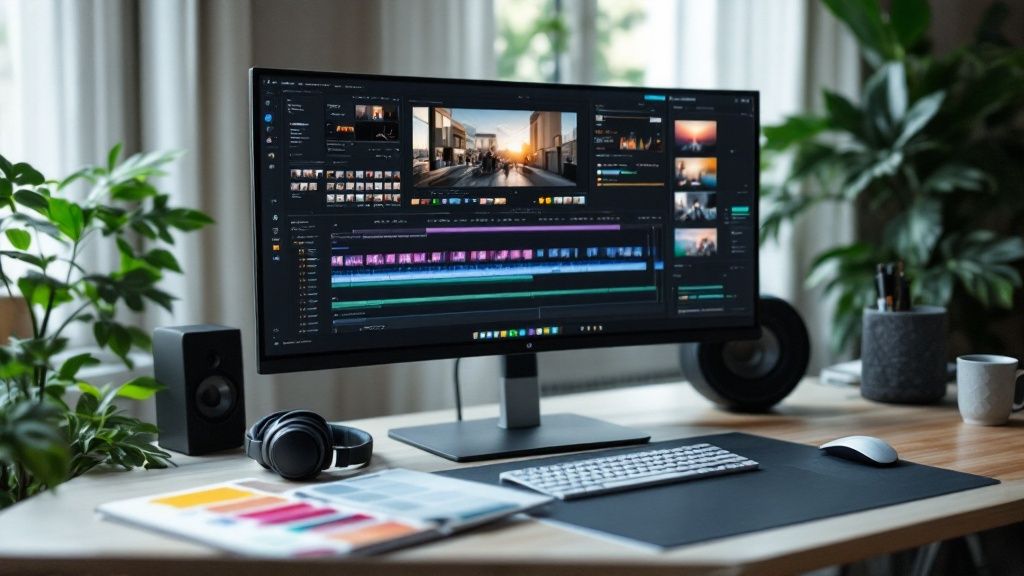
A powerful script gives your video its soul, but the visuals give it a body. This is the stage where compelling words transform into equally compelling images, bringing your explainer video to life. Honestly, this part is less about being an animation wizard and more about thoughtful visual planning.
Your most important tool here is the storyboard. Think of it as the architectural blueprint for your video. A storyboard is just a sequence of simple sketches that maps out every single scene, shot by shot. It lets you pair the script’s narration directly with the on-screen action, making sure your message and visuals are perfectly in sync before you even think about production.
Trust me, this step prevents a world of headaches and costly revisions down the road. By laying everything out first, you can spot pacing issues, catch moments where the visuals don’t quite land with the audio, and figure out how you’re going to illustrate abstract concepts. It’s the single most important part of a smooth creation process.
Designing for Clarity and Connection
With your storyboard as your guide, it’s time to define the visual language of your video. This is where you inject your brand’s personality into every frame. The goal is to create a cohesive, professional look that strengthens your message, not distracts from it.
Here are the key design elements to nail down:
- Color Palette: Stick to your established brand colors to create a consistent look. A limited, strategic palette is almost always more impactful than a chaotic mix of every color under the sun.
- Typography: Choose fonts that are not only on-brand but also highly legible. Any text on screen needs to be crystal clear and easy to read in just a few seconds.
- Character Design: If you’re using animated characters, remember they are a fantastic tool for conveying emotion and making your brand feel more human. Keep the designs simple but expressive to build a genuine connection with your audience.
Visualizing the Intangible
One of the trickiest parts of making an explainer video is showing abstract ideas—things like “synergy,” “data integration,” or “security”—in a concrete way. This is where creative visual metaphors become your best friend.
Instead of just slapping the word “security” on the screen, show it. Animate a shield deflecting digital threats or a vault door locking with a satisfying click. This simple act of translating a concept into a visual action makes the idea instantly understandable and far more memorable.
By really focusing on this visual storytelling phase, you ensure the final product isn’t just a narrated slideshow. It becomes a dynamic, engaging story that clarifies your message and truly connects with your audience.
Measuring Success Beyond the View Count
Okay, you’ve published your video. Now what? While it’s tempting to obsessively refresh the page and watch that view count tick up, that number is only a tiny piece of the puzzle. It tells you how many people clicked play, but it says nothing about the real business impact.
To actually prove the ROI of your explainer video, you need to dig deeper. Your video is a tool, so put it to work. Embed it on your homepage, use it on key landing pages, and arm your sales team with it. Each placement is an opportunity to track performance against real goals.
Tracking What Truly Matters
The real story of your video’s success isn’t in the views—it’s in the engagement and conversion data. These are the numbers that show if your message is pushing people to take action.
- Audience Retention: This is your most important metric. Your video hosting platform’s retention graph is a goldmine. It shows you the exact moment people start dropping off. A sharp dip could mean a confusing point in your script or a visual that isn’t connecting.
- Click-Through Rate (CTR): That call-to-action at the end isn’t just a suggestion—it’s a measurable event. A high CTR on your “Book a Demo” button is a crystal-clear sign your video is persuading viewers.
- Conversion Rate Impact: The ultimate test. Set up an A/B test with two versions of a landing page—one with your video and one without. Comparing conversion rates gives you hard proof of your video’s value.
From Views to Value
Getting a handle on these metrics is non-negotiable. Consider this: a staggering 98% of consumers have watched an explainer video to learn about a product, and 87% say a brand’s video has convinced them to make a purchase. What’s more, 91% of consumers feel that high-quality video positively impacts their trust in a brand. This just underscores why putting in the effort to create a professional video pays off. You can discover more statistics on video marketing effectiveness to see the full picture.
Your goal isn’t just to get views; it’s to hold attention. A video that keeps 70% of its audience watching until the final call to action is far more valuable than one with 10 times the views but only a 10% retention rate.
This data-driven approach shifts your explainer video from just a creative project into a measurable business asset. It gives you the ammunition to show exactly how it contributes to the bottom line. For a more detailed breakdown, our guide on how to measure the success of your marketing videos offers even more actionable strategies.
The Future: Automation and Personalization in Video Creation
The world of video production is moving at a breakneck pace. Not long ago, creating a professional explainer video required a significant budget and an agency on retainer. Today, technology has completely changed the game. Automation and artificial intelligence aren’t just buzzwords; they are fundamentally reshaping how videos get made.
These tools are tearing down the old technical barriers, empowering brands of all sizes to produce high-quality videos in a fraction of the time and cost. But the real revolution isn’t just about speed; it’s about relevance.
From One-Size-Fits-All to Personally Relevant
The era of the generic, one-size-fits-all video is ending. The next frontier is personalization at scale.
Imagine creating slightly different versions of your onboarding video for enterprise clients versus startup founders. Or a product demo that automatically highlights the specific features a user was just browsing on your website. AI-driven tools are making this possible, allowing you to tailor your message to different customer segments or even individual user data.
The real power here isn’t just being more efficient. It’s about being more relevant. A video that speaks directly to a viewer’s specific needs builds a much stronger connection and is far more likely to convert.
This transforms your explainer video from a static asset into a dynamic communication tool. Platforms are emerging that use automation to simplify this once-complex process, making personalized video creation accessible to everyone. An explainer video automation solution like Wideo, for example, provides the tools to create customized, professional videos that connect and convert, without needing an entire animation team.
Common Questions About Explainer Videos
Jumping into explainer video creation usually kicks up a few questions. Getting straight answers from the get-go helps you build a strategy that actually works and move forward with confidence.
How Long Should an Explainer Video Be?
The sweet spot for most explainer videos is between 60 and 90 seconds. That’s typically enough time to introduce a problem, show how you solve it, and drop a clear call to action before you lose anyone’s attention.
But that’s not a hard-and-fast rule. The real answer depends on your goal and where you’re posting it. A deep-dive software demo might need a full two minutes to do it justice, while an ad for social media should probably clock in under 30 seconds. The golden rule? Be as long as you need to be, but as short as you possibly can.
What Is the Best Type of Explainer Video?
There’s no single “best” type—just the best type for your specific goal. It really comes down to what you’re trying to communicate and who you’re talking to.
- 2D Animation is perfect for breaking down abstract concepts, like how your SaaS product works or a complex technical process.
- Live-Action is fantastic for building a human connection and trust, especially when you’re showing off physical products or people-focused services.
- Whiteboard Animation is a classic for a reason. It excels at educational content and walking viewers through something step-by-step.
The right choice will always feel like a natural fit for your brand’s personality, the complexity of your message, and what your audience expects to see from you.
The most effective video is one that feels authentic to your brand and speaks directly to your customer’s needs, regardless of the format.
Can I Create an Explainer Video on a Budget?
Absolutely. You don’t need a massive budget to create something great. While a high-end agency production can run into the thousands, modern tools have made professional-quality video accessible to just about everyone. Platforms now give you everything from templates and stock footage to AI-powered features that slash production costs.
Ready to turn your complex ideas into clear, compelling stories? With Wideo, you get intuitive tools and automation features that let you create professional animated videos in minutes, not weeks. Explore how our explainer video automation solution can help you educate, engage, and convert your audience more effectively.
Related posts:
 How To Increase Your Ecommerce Conversion Rate Using Videos [Infographic]
 Black Friday and Cyber Monday Marketing Video Templates
 How to Increase Your Ecommerce Sales with Video Marketing
 How to use YouTube video ads to drive conversions
 Savvy Tips to Create Engaging Marketing Content
 Product Video for Ecommerce: Accelerate Sales