

ecution. It’s about defining your audience, crafting a script that lands, bringing it to life with animation or live-action, and then getting it in front of the right eyeballs. When done right, your video won’t just get views—it will connect with people and deliver real results.
Why Video Is Your Strongest Marketing Asset

Before we jump into the “how,” let’s lock down the “why.” Video isn’t just another piece of content you can make; it’s a powerhouse for connection and persuasion. In a digital world overflowing with noise, video has a unique way of cutting through. It engages sight and sound at the same time, making your message far more memorable and emotionally impactful than plain text or a static image could ever be.
Think about it from a human angle. We’re hardwired to notice movement and faces. This simple psychological fact is exactly why video marketing is so incredibly effective at building trust. When a potential customer can see a product in action or hear the genuine passion in a founder’s voice, it creates an authenticity that other content formats just can’t replicate. That direct connection helps move people along their buying journey, turning casual browsers into qualified leads.
The Undeniable Dominance of Video Content
The massive shift toward video isn’t just a passing trend—it’s a fundamental change in how we all consume information. The numbers don’t lie; video is quickly becoming the primary language of the internet.
By 2025, video is expected to make up an incredible 82% of all internet traffic. That’s not a small slice of the pie; that is the pie. This tells businesses one clear thing: if you’re not in the video game, you’re becoming invisible. It’s no surprise that 89% of businesses are already using video as a core marketing tool, with most seeing it as absolutely essential to their strategy.
Why the takeover? A few key factors are driving this dominance:
- Higher Engagement: Videos on social media consistently get more shares, likes, and comments than any other type of post.
- Improved Retention: People retain 95% of a message when they see it in a video, compared to just 10% when they read it in text.
- Increased Conversions: Simply adding a video to a landing page can boost conversion rates by over 80%.
Overcoming the Barriers to Entry
For a long time, making a marketing video felt like a huge undertaking. The barriers seemed impossibly high—steep costs, complex equipment, and the need for specialized technical skills. Small businesses and startups often felt that professional-quality video was a luxury reserved for big corporations with even bigger budgets.
That world is gone. The excuses of yesterday have been completely dismantled by modern technology. Everyone has a high-quality camera in their pocket, and incredibly user-friendly platforms like Wideo have democratized the entire production process. You no longer need to be a professional editor or an animation wizard to create a polished, effective marketing video.
Key Takeaway: The question is no longer if you should make a marketing video, but how you can start weaving it into every part of your strategy. With powerful tools now at your fingertips, the only thing holding you back is the decision to start.
Now that we’ve covered the why, let’s break down the process into manageable phases.
Key Steps to Create a Successful Marketing Video
This table provides a bird’s-eye view of the journey from an initial idea to a video that drives results. Each phase builds on the last, ensuring your final product is both creative and effective.
| Phase | Key Objective | Primary Focus |
|---|---|---|
| Strategy & Planning | Define the “why” and “who” | Setting clear goals, identifying the target audience, establishing a budget. |
| Scripting & Storyboarding | Craft the narrative | Writing a compelling script, mapping out scenes visually. |
| Production & Animation | Bring the story to life | Recording footage, creating animations, sourcing music and voiceovers. |
| Post-Production | Polish the final video | Editing scenes, adding graphics, color correcting, and sound mixing. |
| Distribution & Promotion | Get it in front of people | Publishing on key channels, promoting through ads, email, and social media. |
| Analysis & Optimization | Measure and improve | Tracking performance metrics and using insights to inform future videos. |
Think of this as your roadmap. Following these steps will help you stay organized and ensure no crucial details are missed along the way.
With the right approach, you can create compelling content that grabs attention, builds trust, and helps grow your business. For an even deeper look at the business case, check out our guide on why you should use video for marketing.
Building Your Video Marketing Blueprint

Before you even think about hitting record or opening up an animation tool, the real work begins. An effective marketing video isn’t just a random spark of creativity; it’s a calculated business move that needs a solid strategic foundation. This blueprint phase is where you make sure your video has a purpose, speaks to the right people, and is built to deliver a specific, measurable result.
Trying to skip this part is like building a house without plans. Sure, you might end up with something that looks okay from a distance, but it won’t be functional or stand the test of time. A little strategy upfront saves you countless hours of rework later and dramatically boosts your chances of success.
Define Your Ideal Viewer
So, who are you actually talking to? If your answer is “everyone,” you’ve already lost. To create a video that truly connects, you need a crystal-clear picture of your ideal viewer. This goes way beyond basic demographics; we’re talking about building a detailed audience persona.
Give this person a name, a job, maybe even a backstory. What are their daily frustrations? What keeps them up at night? Understanding their pain points is the secret sauce to crafting a message that genuinely resonates.
- For a B2B Software Company: Your persona might be “Marketing Manager Maria.” She’s drowning in data and desperately needs a simpler way to track campaign ROI to prove her team’s value to the higher-ups.
- For an E-commerce Brand: You could be targeting “Busy Mom Brenda.” She values convenience above all else and is on the hunt for healthy, quick meal options for her family. Her biggest pain point? A total lack of time.
Knowing these little details helps you tailor everything—from the script’s tone to the visual style—to grab their attention and earn their trust.
Set Clear and Measurable Goals
Your video needs a job. What specific action do you want someone to take after watching it? A video without a clear goal is just entertainment; a marketing video has to drive a business result. Your objective will directly shape the video’s content, length, and call-to-action (CTA).
Pick one primary goal that is both specific and measurable. For example:
- Increase Brand Awareness: The mission here is to introduce your brand to a new crowd. Success is measured by things like reach, impressions, and total video views.
- Generate Qualified Leads: In this case, you want to capture contact info. Your key metric is the number of form submissions or demo requests your video brings in.
- Drive Direct Sales: The goal is simple: get people to buy something. You’ll track success by looking at click-through rates on “buy now” buttons and, of course, conversion rates.
A video designed to generate leads will look very different from one designed for brand awareness. The lead-gen video might end with a strong CTA to download a guide, while the awareness video might just ask viewers to follow you on social media.
Choose the Right Video Format
Okay, you know your audience and you’ve set your goals. Now you can pick the best format to get your message across. Different video types work best at different stages of the customer journey, so you need to match the format to the goal.
There’s a whole world of formats out there, but some are popular for a reason. Explainer videos, for instance, are a massive hit, with 73% of marketers using them to break down complex topics. At the same time, live-action videos are the most created format overall, making up 48% of all marketing videos thanks to their authentic, human feel. You can discover more insights about video marketing statistics on Wyzowl.com.
Let’s look at a few go-to formats and when they shine:
| Video Format | Best Use Case | Primary Goal |
|---|---|---|
| Explainer Video | Simplifying a complex product, service, or idea. | Education & Lead Generation |
| Social Media Clip | Grabbing attention quickly on feeds like Instagram or TikTok. | Brand Awareness & Engagement |
| Testimonial Video | Building trust and credibility with social proof. | Conversion & Sales |
| Product Demo | Showcasing how your product works in a real-world scenario. | Lead Generation & Sales |
By thoughtfully creating this blueprint—defining your audience, setting goals, and choosing the right format—you’re no longer just making a video. You’re engineering a powerful marketing asset designed for maximum impact.
Crafting a Script That Connects
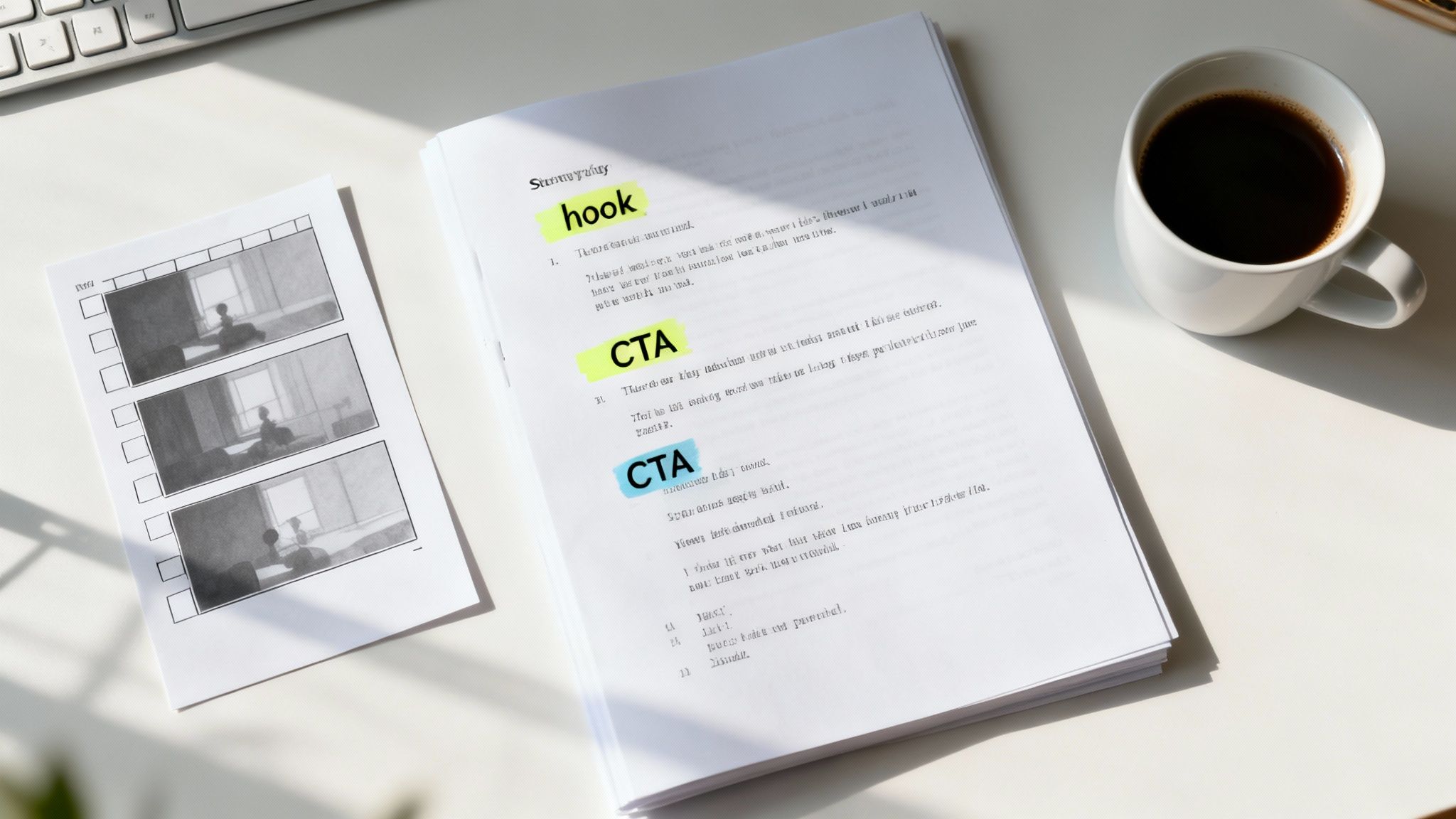
Alright, you’ve got your strategy nailed down. Now for the fun part: breathing life into your message. Your script is the absolute heart of your marketing video. It’s where abstract goals become a story that actually gets people to do something.
A great video isn’t about flashy graphics—it’s driven by a solid narrative that connects with people. Let’s ditch the stiff corporate jargon and salesy language. We’re here to tell a story, and every good story has a clear beginning, middle, and end.
The Four-Part Narrative Structure
You don’t need to reinvent the wheel to write a script that works. There’s a simple, proven four-part structure that provides a reliable framework for grabbing attention, building empathy, and guiding your viewer to the finish line. It’s a classic for a reason—it mirrors how people process information and make decisions.
Here’s the breakdown:
- The Hook: You have maybe 5-8 seconds to stop the scroll. Seriously. Kick things off with a surprising statistic, a relatable question, or a bold statement that hits on their biggest pain point right away.
- The Problem: You’ve got their attention. Now, show them you get it. Describe the problem they’re dealing with using their own words. This is where all that audience persona research pays off big time, building trust and empathy.
- The Solution: Time to gently introduce your product or service as the hero of the story. Don’t just rattle off a list of features; talk about the benefits. Show—don’t just tell—how you solve their problem and make their life easier.
- The Call-to-Action (CTA): End with one clear, direct instruction. What’s the one thing you want them to do next? Make it impossible to misunderstand. “Start Your Free Trial.” “Download the Guide.” Simple.
This structure turns a boring ad into a mini-story where your customer is the protagonist and your brand is their trusted guide.
Writing Dialogue That Sounds Human
One of the biggest mistakes I see is scripts that sound like they were pulled from a marketing brochure. Remember, you’re writing for the ear, not the eye.
The best way to gut-check this? Read every single line out loud while you’re writing.
Does it sound like something a real person would actually say? If not, rewrite it. Use contractions like “you’re” and “it’s.” Keep your sentences short and punchy. This one simple habit will make your voiceover sound authentic and relatable, not robotic.
Pro Tip: When scripting, a good conversational pace is about 150 words per minute. For a 90-second video, that means your script should be around 225 words. Keeping it tight forces you to focus only on what truly matters.
If you want to go deeper on this, our guide on how to write an effective explainer video script has a ton more techniques and examples.
From Words to Pictures with Storyboarding
Once your script is locked in, the next step is a total game-changer: the storyboard. A storyboard is just a visual outline of your video, scene by scene, like a comic book version of your script. It maps out exactly what will be on screen and when.
I know it feels like an extra step you could skip, but trust me, it will save you a world of headaches during the animation phase.
Your storyboard doesn’t have to be a work of art. Stick figures and basic shapes are perfectly fine. The goal is simply to plan the visual flow and make sure your script and visuals are working together.
For each scene, your storyboard should quickly detail:
- The Shot: A quick sketch of the main visual elements.
- The Action: A short description of what’s moving or happening.
- The Dialogue/Voiceover: The matching lines from your script.
- Text & Graphics: Any on-screen text or icons that need to pop up.
This visual roadmap gets everyone on the same page, clarifies the vision, and helps you spot problems before you start animating. It’s the key to making sure the final video is cohesive, powerful, and tells the exact story you wanted to tell.
Bringing Your Vision to Life
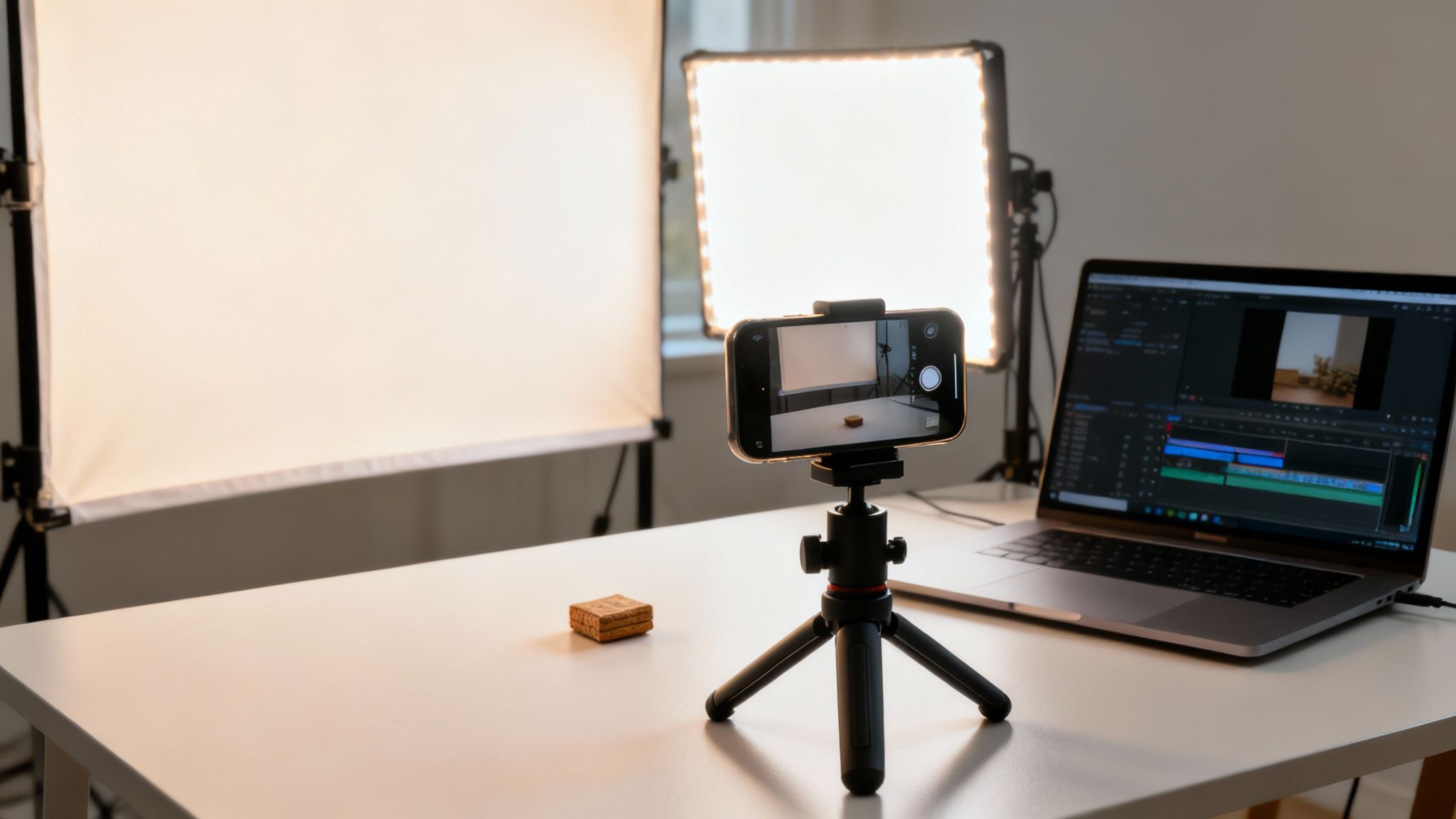
With a solid script and storyboard in hand, it’s time for the fun part—moving from planning to production. This is where your ideas finally start taking shape on screen. Whether you’re leaning toward the authenticity of live-action or the dynamic storytelling of animation, producing a professional-looking video is more achievable than ever.
The key isn’t a Hollywood-level budget. It’s about being smart with the resources you have and focusing on a few core elements that have an outsized impact on the final product.
The Live-Action Approach: DIY Filming Tips
Shooting a live-action video can feel intimidating, but you probably have a more-than-capable camera in your pocket right now. Modern smartphones shoot in stunning 4K, which means your primary focus should be on two things that amateurs almost always overlook: lighting and audio.
Good lighting is non-negotiable. It’s the difference between a crisp, professional shot and a grainy, amateur one. You don’t need expensive studio lights to get it right, either.
- Natural Light is Your Best Friend: Position your subject facing a window to get soft, flattering light. Just be sure to avoid shooting with a bright window behind them, as this will create a distracting silhouette.
- Simple Ring Lights: For a small investment, a basic ring light provides consistent, even lighting that eliminates harsh shadows on faces.
Clean audio is just as crucial. Viewers will forgive slightly imperfect video quality, but they will click away instantly if the audio is muffled or full of background noise. A simple lavalier microphone that clips onto a shirt is a small investment that makes a massive difference.
The Animation Path: Using Templates and Tools
If live-action isn’t the right fit, animation offers incredible creative freedom. Platforms like Wideo are designed to make this process incredibly straightforward, even for complete beginners. You can create a polished, engaging animated video without needing to draw a single frame from scratch.
The secret? Start with a template. Wideo provides a massive library of pre-designed templates tailored for specific goals—like explaining a service, promoting an event, or creating a social media ad. This gives you a professional foundation to build upon.
Customization from there is a breeze:
- Swap in Your Branding: Easily change the color palette to match your brand and upload your logo.
- Customize Characters and Objects: Drag and drop different characters, props, and backgrounds from the library to fit your script.
- Animate with a Click: Apply smooth, pre-built transitions and animations to objects and text to bring your scenes to life.
This template-driven approach dramatically cuts down production time and ensures your final video has a cohesive, professionally designed look.
Perfecting Your Voiceover
Whether you choose live-action or animation, your video needs a voice. The narration guides the story, and its quality directly reflects on your brand’s credibility. You’ve got two great options here.
Recording Your Own Voiceover
If you have a clear, confident voice, recording it yourself can add a wonderful layer of authenticity. You don’t need a soundproof booth. Just find a quiet room with soft surfaces (like a closet full of clothes) to reduce echo and use a quality USB microphone for the best results.
Using AI Text-to-Speech
For a perfectly consistent and clear voice, AI-powered text-to-speech (TTS) is an amazing tool. Modern TTS engines sound remarkably human and can generate a flawless voiceover in seconds. It’s a huge time-saver and ensures a polished, professional sound every time.
The quality of your video has a direct and measurable impact on brand trust. Getting the production details right—from clear audio to clean visuals—is essential for building credibility with your audience.
Ultimately, the goal is to create something that looks and sounds so professional that the viewer focuses on your message, not on distracting technical flaws. Audiences are becoming more discerning; research shows that by 2025, an overwhelming 91% of consumers will say video quality directly impacts their trust in a brand. This just underscores how important it is to get production right. To keep up with what’s next, you can explore more 2025 video marketing trends on WordStream.
Once you’ve captured your footage, mastering the post-production process is key. Exploring options for drone video editing software can show you how different tools can elevate your final product. No matter which path you choose, focusing on these fundamental production elements will ensure your video is ready to make a powerful impression.
Getting Your Video Seen by the Right People
Making a fantastic marketing video is a huge win, but honestly, that’s only half the job. An incredible video that nobody sees is a massive missed opportunity. The last, and arguably most important, phase of making a marketing video is distribution—having a smart plan to get your content in front of the right eyeballs at the right time.
You can’t just upload it and hope for the best. That’s a recipe for disappointment. A solid, multi-channel distribution strategy is what ensures all your hard work pays off, maximizing both your reach and your return on investment.
Optimize Your Video for Each Platform
Every platform has its own unwritten rules, its own vibe. A one-size-fits-all approach simply falls flat in today’s social media world. To really connect, you’ve got to tweak your video to fit the context and audience expectations of each channel.
This goes way beyond just uploading the same file everywhere. It’s about strategic optimization.
- For YouTube: You have to treat it like a search engine. Your title and description need to be packed with the keywords your target audience is actually typing into that search bar. And don’t forget a compelling, custom thumbnail that practically begs to be clicked.
- For Instagram & TikTok: Go vertical, no questions asked. These platforms are built for a 9:16 aspect ratio. Keep it short, make it punchy, and make sure you grab their attention in the first three seconds or they’re gone.
- For LinkedIn: Keep it professional and deliver real value. Your video should be offering up industry insights, solving a common business problem, or sharing a customer success story. Always add subtitles—a massive 85% of social media videos are watched with the sound off.
Key Insight: The goal isn’t just to be on multiple platforms; it’s to be a native. Tailoring your video format and messaging for each channel shows your audience you get it, and you respect how they consume content.
Integrate Video Across Your Marketing Funnel
Don’t just think of your video as a social media post. It’s a super versatile asset that can beef up every single touchpoint in your customer’s journey. By strategically embedding your video, you can seriously boost engagement and conversions across all the channels you own.
Think about where your video could make the biggest splash:
- Your Website: Drop that new explainer video right on your homepage to quickly show visitors what you’re all about. Got a cool product? Add a demo video to its feature page to show how it works instead of just talking about it.
- Email Campaigns: Did you know video in email can skyrocket click-through rates by up to 300%? A simple static thumbnail with a play button that links out to the video on a landing page works wonders in nurture sequences, product announcements, and onboarding emails.
- Sales Enablement: Give your sales team some powerful new ammo. They can share customer testimonials or short demo clips in their outreach to build instant credibility and answer common questions before a call even gets booked.
By weaving your video into these core channels, you create a much more persuasive and connected brand experience. For a deeper dive, check out our guide to sharing your marketing videos online for maximum exposure.
Amplify Your Reach with Paid Promotion
Organic reach is awesome, but sometimes your video needs a little nudge to find a bigger, more targeted audience. Paid promotion lets you zero in on your ideal customer with scary-good precision, making sure your message lands exactly where you want it.
When you set up a targeted ad campaign on a platform like Facebook or LinkedIn, you can define your audience by demographics, interests, job titles, and online behavior. That means you can show your video directly to “Marketing Managers in the SaaS industry” or “small business owners interested in e-commerce.”
To give your video an extra organic boost, think about using an influencer seeding strategy to get your content in front of key voices in your niche. Even a small, targeted ad spend can dramatically expand your video’s visibility and drive qualified traffic, turning viewers into leads and, eventually, customers.
Of course, here is the rewritten section with a completely human-written and natural tone, following the provided style guide and examples.
Your Marketing Video Questions, Answered
Jumping into video creation means you’re going to have questions. It’s a fast-moving space, and even marketers who’ve been at this for years are always picking up new tricks. I’ve put together answers to some of the most common questions we get, aiming for clear, no-fluff advice to help you get ahead.
Think of this as your personal cheat sheet. These are the kinds of insights that can save you a ton of time, boost your results, and give you the confidence to really nail your video strategy.
How Long Should My Marketing Video Be?
Ah, the million-dollar question. The honest answer is always: it depends entirely on the platform and what you’re trying to achieve. There’s no magical “perfect” length. The real goal is to match your video’s duration to the viewer’s mindset on that specific channel.
Here’s a practical breakdown for different scenarios:
- Social Media Feeds (Instagram, TikTok, Facebook): Keep it short and sweet, between 15-60 seconds. Your mission here is to stop the scroll and land a memorable message almost instantly.
- Website Homepage or Explainer Video: The sweet spot is usually 1-3 minutes. People on your site are already curious, so you have a bit more time to lay out your value and show them what to do next.
- In-Depth Content (Webinars, Tutorials): These can go much longer, anywhere from 30-60 minutes. The audience here is looking for detailed information and is ready to invest the time.
The bottom line? Get to the point fast and keep things interesting. If your three-minute video feels like it drags, it’s too long.
Do I Need Expensive Equipment to Make a Good Video?
Definitely not. This is probably the biggest myth holding people back from learning how to make a marketing video. You can get high-quality results with a lot less than you think.
Your smartphone probably shoots in beautiful 4K, which is more than enough for most professional needs. The smartest places to put your money are actually in good audio and lighting.
Viewers will forgive slightly shaky visuals, but they will absolutely not stick around for bad audio. A simple lavalier mic and a basic ring light will do more for your video’s perceived quality than a fancy camera ever could.
Get those two things right, and you’re already way ahead of the game.
What’s the Biggest Mistake People Make in Video Marketing?
Easy. The single biggest mistake is diving in and creating a video without a clear, written-down strategy. This is what happens when you get excited about the “what” (making a video) before you’ve figured out the “why” and the “who.”
A beautiful video is a total waste if it doesn’t have a job to do. This usually looks like:
- No defined audience: Who are you even trying to talk to?
- No specific goal: What do you want people to do after watching?
- No distribution plan: How are people going to find this thing?
Always, always start with your strategy. A well-planned, decent-quality video will outperform a stunningly produced video with no real plan behind it every single time.
Ready to turn your strategic plan into a stunning animated video? Wideo gives you all the tools you need—from customizable templates to an intuitive drag-and-drop editor. Create your first professional marketing video for free today!
Related posts:
 A Guide to AI Video Creation for Beginners
 AI Avatars: The New Face of Business Communication
 AI Avatars: The Secret Weapon for Business Growth and Efficiency
 12 Powerful AI Tools for Video Creators in 2025
 Artificial Intelligence Is Now the Operating System for Modern Life
 Machine Learning Ends Generic Video Marketing