
Let’s be honest. The conversation around AI productivity is stuck on small wins. Shaving a few minutes off writing an email or summarizing meeting notes is helpful, but it’s not a breakthrough. It’s just doing the same old tasks a little faster.
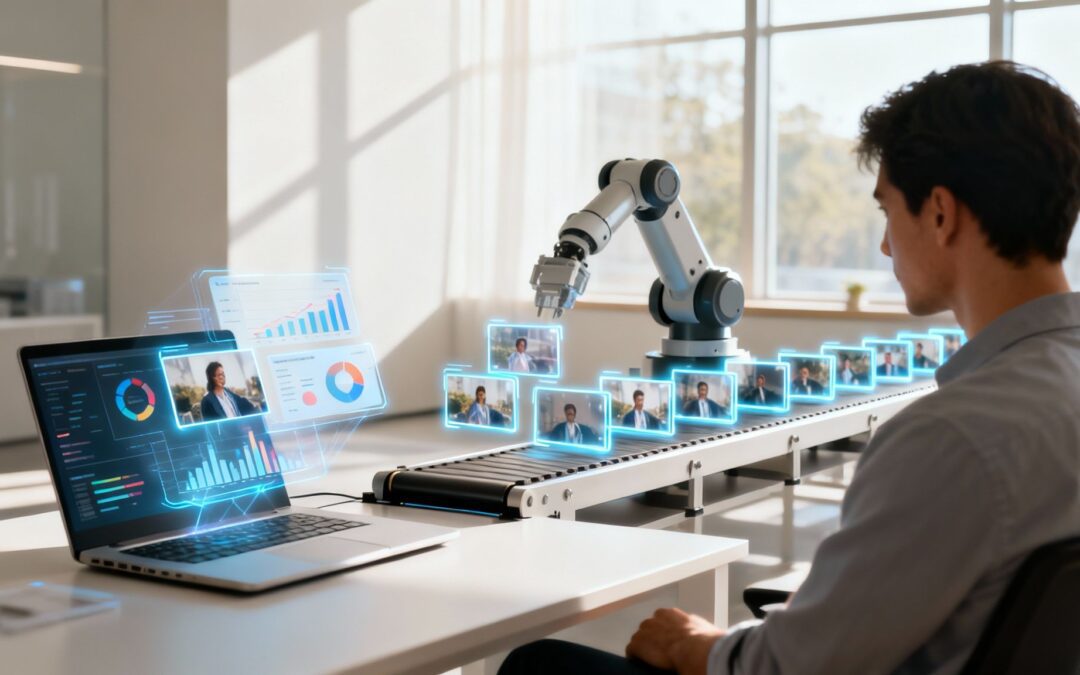
The real transformation happens when AI doesn’t just speed up a task—it eliminates the entire workflow. The goal isn’t a slightly faster email. It’s an automated system that creates and sends a thousand personalized videos, making those one-off emails obsolete.
This is the shift from incremental gains to exponential impact. It’s where AI productivity stops being a buzzword and starts changing how your business operates.
The Real Bottleneck in Your Workflow: Video

For any team in marketing, sales, or customer success, the biggest drain on time, resources, and creative energy is almost always video. We all know video works, but the traditional production process is a productivity black hole. It’s slow, expensive, and filled with manual steps that kill momentum.
This friction is why so many teams struggle to scale their video efforts. Stanford’s 2025 AI Index report shows massive AI adoption, yet many companies see little return because they’re trying to optimize broken processes.
True AI productivity isn’t about finding time-saving tips for better animated videos. It’s about fundamentally changing the game.
Productivity, redefined for the AI era, is the ability to:
- Create more video content without increasing your team’s workload.
- Personalize communication at a scale that was never humanly possible.
- Reduce manual production steps from weeks to minutes.
- Replace repetitive coordination with automated video systems.
- Turn raw data into video automatically.
This isn’t about working faster. It’s about building systems that work for you.
From Manual Grind to Automated Flow
Imagine a sales rep who wants to send a follow-up video after a demo. The old way is a mess of manual effort.
Old Workflow: The “Quick” Personalized Video
- Manual Recording: The rep spends 30 minutes trying to record a decent two-minute video, fumbling through multiple takes.
- Clumsy Editing: They waste another 20 minutes trimming the start and end.
- Coordination Delays: They email marketing for a branded thumbnail, adding another bottleneck.
- The Result: Nearly an hour is gone for one video sent to one prospect. Scaling this across a team is impossible.
Now, let’s look at the same scenario through the lens of AI-driven productivity.
AI-Driven Workflow: The Automated Video System
- The Trigger: The rep marks the demo “complete” in the CRM.
- Automated Creation: An AI system instantly pulls the prospect’s name, company, and key discussion points from the CRM record and generates a personalized video from a pre-approved template.
- Instant Delivery: The finished, on-brand video is automatically added to a follow-up email and sent.
- The Result: The rep is already on their next call. A perfectly tailored, high-impact touchpoint was created with zero manual effort.
That’s the difference. We’ve moved from a time-consuming task to a self-running system.
Your Biggest Enemy: Decision Fatigue

The hidden cost of manual video production isn’t just time—it’s decision fatigue. Every video is a gauntlet of hundreds of tiny, low-impact choices.
- Which take sounds better?
- Is this the right background music?
- Is the logo positioned correctly?
- Did I get the latest brand guidelines?
This constant mental load drains your team’s creative energy, pulling them away from strategic thinking and into the weeds of execution. AI productivity solves this by automating the small decisions, freeing up human brainpower for what matters most: the message, the strategy, and the customer.
When you have a system where one video template can generate thousands of personalized outputs, you’re not just saving hours. You’re preserving your team’s most valuable resource: their focus.
How AI Turns Data into Effortless Communication

The most powerful application of AI productivity is turning the data you already have into a continuous stream of video communication. Instead of treating each video as a separate project, you build an engine that runs on its own, triggered by the events and data that drive your business.
Your team stops being content creators and becomes system architects. They design the machine; AI runs it. This is how you build your own self-running AI marketing machine.
Scenario: The Self-Updating Training Library
Consider an HR team responsible for dozens of training videos.
Old Workflow:
Every time a company policy or software feature is updated, the team has to manually re-record, re-edit, and re-upload the relevant training video. It’s a never-ending cycle of tedious work, and the content is almost always out of date.
AI-Driven Workflow:
The team connects a knowledge base or a simple spreadsheet to a video template. When a policy is updated in the source document, a trigger automatically generates a new, updated training video in seconds. The library is always current, with zero manual production effort.
Scenario: Personalized Marketing at Scale
A marketing team wants to send weekly performance updates to hundreds of clients.
Old Workflow:
An account manager spends an entire day each week manually pulling data, plugging it into a presentation deck, and writing a summary email for each client. The process is prone to error and impossible to scale.
AI-Driven Workflow:
An automated system connects to the client database. Every Monday morning, it pulls each client’s latest performance metrics, generates a personalized video report highlighting their key results, and sends it automatically. What once took a full day now happens in minutes.
The common thread here is a shift in mindset:
- One video template → thousands of personalized outputs
- One workflow → continuous video communication
- One system → consistent, on-brand messaging across all teams
For teams looking to turn AI productivity into real output, automated video workflows—like those enabled by Wideo’s Video Automation—make it possible to scale video communication without adding complexity or production time.
Putting Your AI Video Engine to Work
So, how do you make this practical? Setting up an automated video workflow is about connecting the tools and data you already use. It’s about building a bridge between your information and your communication.
The goal is to move from reactive, one-off video tasks to a proactive, “always-on” communication system that works for you 24/7.
Here are a few high-impact examples you can implement today:
- Automated Sales Videos: Trigger a personalized welcome video the moment a new lead enters your CRM. Use their name, company, and industry to create an instant, relevant connection.
- Data-Driven Reports: Stop building slide decks. Connect a Google Sheet with weekly business metrics to a video template and automatically generate a video summary for your team or stakeholders.
- Dynamic Onboarding: Create onboarding videos for new hires that automatically pull their name, team, and manager’s details for a personalized welcome experience.
This isn’t just about using an AI video generator to create a single video. It’s about designing a system where events themselves trigger the creation and delivery of perfectly timed, relevant video messages. This is what unlocks true scale.
The Real Payoff: More Impact, Less Effort
The ultimate benefit of AI productivity in video isn’t just efficiency. It’s about unlocking a level of impact that was previously out of reach.
When video creation is no longer a bottleneck, your teams can communicate more effectively, more personally, and more consistently.
- Sales teams build stronger relationships with hyper-personalized outreach.
- Marketing teams engage audiences with tailored messages instead of generic broadcasts.
- Customer success teams provide proactive support with timely, automated video updates.
This systematic approach has a proven track record. By implementing automated video systems, some teams have seen their output increase by over 20 times, as shown in this case study on enhanced productivity. The projected impact of generative AI on future productivity highlights that these systemic changes are where the true economic value lies.
AI productivity becomes real when video creation stops being the bottleneck.
It’s about redesigning your workflows so that high-quality, personalized video is no longer a major project, but an effortless, automated part of how your business communicates. That’s not just a small win—it’s a competitive advantage.
Got Questions? We’ve Got Answers
Stepping into the world of AI-driven video workflows can bring up a few questions. That’s perfectly normal. Here, we’ll tackle some of the most common ones we hear about using automated systems to get more done and be more creative.
Does AI Video Automation Replace Creative Teams?
Not a chance. Think of AI video automation as a super-powered assistant for your creative team, not a replacement. Its job is to take on the repetitive, mind-numbing tasks that slow creatives down, so they can get back to doing what they do best.
Instead of being stuck in the weeds making tiny edits across dozens of video variations, your team can put their energy into high-value work:
- Crafting master templates that set the visual tone and brand feel for all your videos.
- Shaping high-level brand strategy and making sure every automated video is perfectly on-point.
- Dreaming up unique, big-impact campaign concepts that need real human creativity and storytelling chops.
AI is a force multiplier for creativity. It handles the tedious grunt work, letting your team focus on the vision and innovation that truly moves the needle.
What Kind of Data Do I Need to Automate Personalized Videos?
You can get started with the simple, structured data you already have. If it’s in a spreadsheet, a database, or a CRM, you’re good to go. The automation platform just needs to be able to map that data to your video templates.
Here are a few real-world examples:
- For Sales Teams: Use prospect names, company names, and job titles straight from your CRM to create personalized outreach videos that grab attention.
- For Marketing Teams: Pull product names, prices, and images from a Google Sheet or product catalog to generate dynamic ads and promos.
- For Internal Comms: Use employee names and team stats from a spreadsheet to automate weekly update videos or celebrate team wins.
The system simply takes the data from each row and plugs it into the variables in your video template, churning out a unique version for every entry.
How Hard Is It to Set Up an Automated Video Workflow?
You don’t need to be a developer to get this done. Modern video automation platforms are built for business users, and most workflows can be set up quickly using no-code tools.
The whole process usually boils down to three simple steps:
- Design a master video template and add placeholders for the content you want to personalize.
- Connect your data source, whether that’s a HubSpot CRM, a simple Google Sheet, or an API.
- Set the trigger that kicks off the video creation—like a new lead popping up in your CRM or a new row being added to your spreadsheet.
Related posts:
 How AI Applications Are Reshaping Modern Industries
 A Practical Guide to Implementing AI Solutions
 The Top 10 AI Trends Marketers Must Watch in 2025
 A Practical Guide to AI Innovation and Business Growth
 Ai Avatar Mastery: Create Your ai avatar for Marketing
 A Practical Guide to AI Avatar Generator Tools


